
Are Your Tendons Happy? What Wearable Tech Can Tell Us About Foot Health
July 3, 2026
No Arch, No Problem: Top Orthopedic Slippers for Flat Feet
July 7, 2026
The Ultimate Guide to Relieving Rhomboid Trigger Points
That Nagging Pain Between Your Shoulder Blades Could Be a Rhomboid Trigger Point
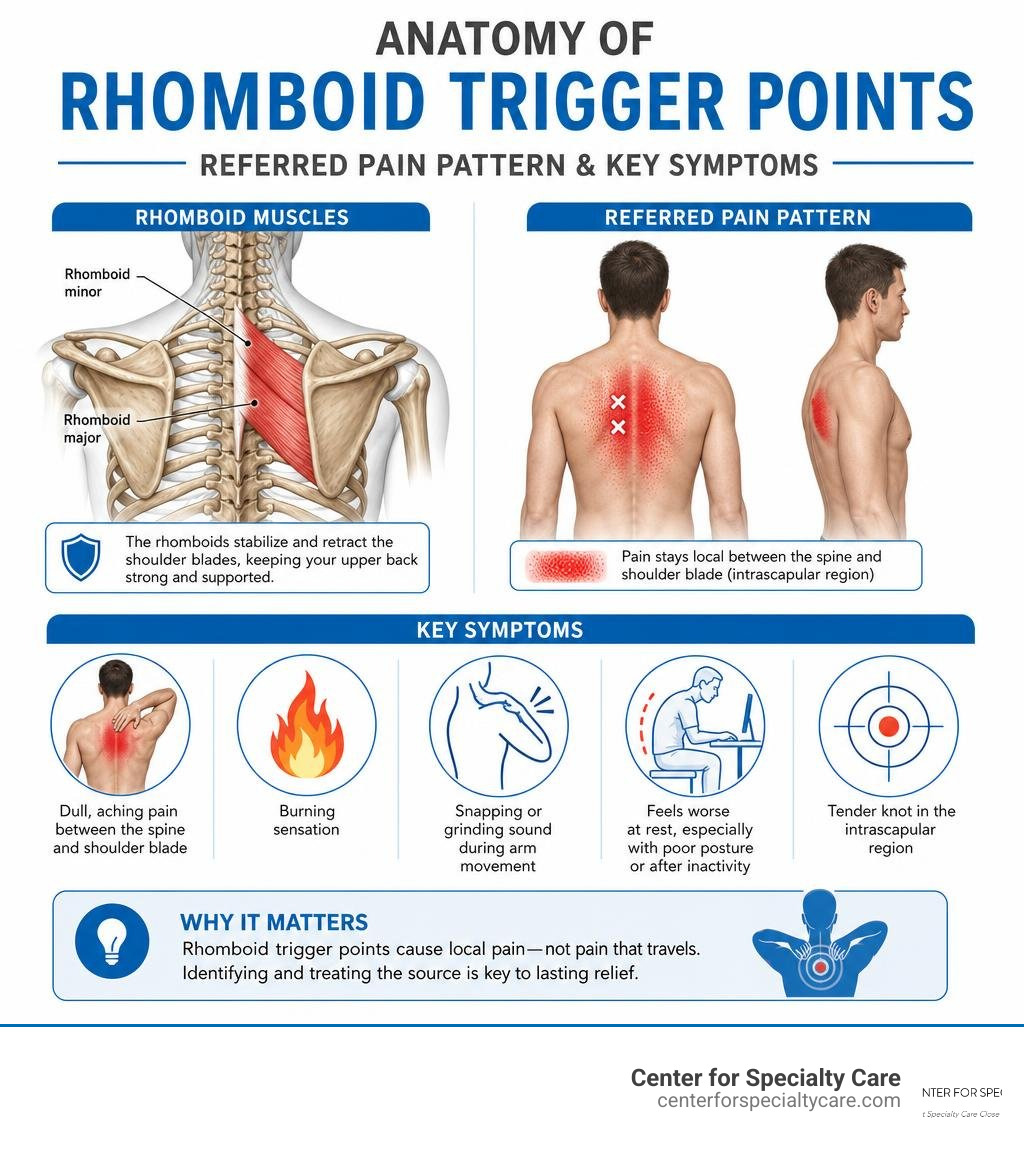
A rhomboid trigger point is a hyperirritable knot in the rhomboid muscles — the muscles that run between your spine and shoulder blades. These knots cause a dull, aching pain in your mid-back that can be hard to shake.
Here is a quick overview of what you need to know:
- What it feels like: Superficial, aching pain between the spine and shoulder blade, sometimes with a burning sensation or a snapping/grinding sound during arm movement
- Where it hurts: Primarily in the intrascapular region (between spine and shoulder blade); pain stays local and does not travel to the neck
- Common causes: Rounded-shoulder posture, prolonged desk work, side sleeping, overhead sports
- How to release it: Manual pressure (ischemic compression), stretching, dry needling, postisometric relaxation, and targeted exercises
- When to see a doctor: If pain is severe, persistent, or accompanied by numbness, weakness, or chest pain
Most people feel this pain at rest — not during movement — and instinctively reach back to rub the area. That urge to press on it is actually your body pointing you toward the right treatment.
This guide walks you through everything: anatomy, causes, symptoms, diagnosis, and the most effective ways to find relief — both at home and in a clinical setting.
I’m Dr. Corey Welchlin, a board-certified orthopedic surgeon and sports medicine physician with over 30 years of experience diagnosing and treating musculoskeletal pain, including complex cases involving rhomboid trigger points and upper back dysfunction. As the founder of the Center for Specialty Care in Fairmont, Minnesota, I’ve helped countless patients move from chronic pain to lasting relief through both conservative and surgical approaches.
Rhomboid trigger point terms explained:
Understanding the Rhomboid Trigger Point: Anatomy and Symptoms
To understand how a rhomboid trigger point develops, it helps to look at what is happening inside the muscle tissue. A myofascial trigger point is a hyperirritable spot located within a taut band of skeletal muscle fibers. When these muscle fibers remain in a constant state of contraction, they create a small, palpable nodule—what we commonly call a muscle “knot.”
This localized contraction creates an “energy crisis” within the muscle tissue. The constant tension compresses nearby capillaries, restricting local blood flow and depriving the muscle of oxygen and essential nutrients. This lack of circulation causes metabolic waste products to accumulate, which irritates local nerve endings and produces a dull, superficial aching pain.

For many of us, this issue is driven by chronic postural habits, such as rounded shoulders and a sunken chest. When we slouch forward at our desks, our shoulder blades are pulled forward and away from the spine. This forces the rhomboid muscles into a chronically stretched, lengthened position under constant tension. Over time, this constant mechanical strain triggers the formation of painful knots. If you want to dive deeper into how these knots form and how they differ from other muscle injuries, you can learn about knots in the rhomboid.
Anatomy and Function of the Rhomboid Muscles
The rhomboid muscle group consists of two distinct muscles located in the upper back, lying just deep to the larger trapezius muscle:
- Rhomboid Minor: The smaller of the two muscles, the rhomboid minor originates from the ligamentum nuchae and the spinous processes of the C7 and T1 vertebrae. It inserts into the medial border of the scapula at the level of the scapular spine.
- Rhomboid Major: Roughly twice as wide as the minor, the rhomboid major originates from the spinous processes of the T2 through T5 vertebrae and inserts along the medial border of the scapula, extending down to the inferior angle.
Both of these muscles are innervated by the dorsal scapular nerve (originating from the C5 nerve root). Together, their primary functional roles are scapular retraction (pulling the shoulder blades toward the spine), elevation, and downward rotation of the scapula. They also play a vital role in stabilizing the shoulder girdle during arm movements, working in harmony with the serratus anterior muscle to prevent scapular winging. Understanding this delicate muscular balance is essential for long-term recovery; you can read more info about rhomboid strain recovery to understand how these muscles heal.
Common Causes of a Rhomboid Trigger Point
Myofascial trigger points in the rhomboids rarely develop in isolation. Instead, they are typically the result of repetitive microtrauma, acute overload, or chronic postural stress.
- Poor Posture: Spending long hours hunched over a computer, laptop, or smartphone is the leading cause of upper back pain. This forward-head, rounded-shoulder posture places a continuous, exhausting tensile load on the rhomboids.
- Muscle Overload: Repetitive overhead activities, such as throwing sports, tennis, badminton, or painting a ceiling, can rapidly exhaust the scapular stabilizers.
- Side Sleeping: Sleeping on your side without adequate support can compress the shoulder girdle forward, shortening the chest muscles and placing the rhomboids under a prolonged stretch all night. To prevent this, we recommend placing a supportive pillow under your armpit to keep your shoulder in a neutral position. You can read about sleeping positions for rhomboid pain to find the best layout for a pain-free night.
Referred Pain Patterns and Symptoms
Unlike many other muscles in the body that refer pain to distant areas, a rhomboid trigger point primarily produces localized, superficial aching pain. This pain is concentrated in the intrascapular region—the space between your spine and the medial border of your shoulder blade.
However, patients also frequently report:
- A superficial, nagging ache that is felt mostly at rest and is not heavily modified by movement.
- A persistent urge to reach back and rub or press on the area between the shoulder blade and the spine.
- Snapping, clicking, or grinding noises around the shoulder blade during arm movements, often caused by altered scapular tracking.
- Occasional referred pain or tension extending upward toward the supraspinatus region (the top of the shoulder blade), though the pain notably does not travel up into the neck itself.
To explore these symptoms and their clinical clinical presentations in greater detail, you can read the scientific research on rhomboid trigger points published in leading manual therapy texts.
Diagnosis and Clinical Treatment Options
When a patient visits our clinic complaining of persistent pain between the shoulder blades, we perform a comprehensive physical examination. Because the rhomboids are positioned directly beneath the trapezius muscle, diagnosing a rhomboid trigger point requires precise palpation.
To isolate the rhomboids and relax the overlying trapezius, we have the patient place the back of their hand on the small of their back. This relaxes the trapezius, allowing us to palpate along the medial border of the scapula. We search for a taut band of muscle fibers and a highly tender, nodular trigger point. Pressing on an active trigger point will often elicit a “jump sign”—an involuntary flinch or jump from the patient due to sudden pain.

It is also crucial to differentiate rhomboid pain from other conditions. For example, “scapulocostal syndrome” is a term sometimes used to describe pain in this region, but it is frequently a misdiagnosis for untreated myofascial trigger points. We must also evaluate the thoracic spine, as articular dysfunction in the upper thoracic vertebrae can mimic or contribute to rhomboid pain. Additionally, sudden physical trauma can trigger these issues; you can learn why car accidents cause rhomboid pain to see how acute whiplash or seatbelt impact strains the upper back.
Ischemic Compression vs. Postisometric Relaxation
Two of the most widely researched and effective manual therapy techniques for managing latent and active trigger points are ischemic pressure (also known as ischemic compression) and postisometric relaxation (PIR).
- Ischemic Pressure: This technique involves applying a gradual, sustained, and tolerable pressure directly over the trigger point using a thumb, elbow, or specialized tool. The pressure is held until the clinician feels the tissue barrier “give” or soften, at which point the pressure is gently increased. This equalizes sarcomere length in the trigger point and induces a state of reactive hyperemia (a rush of fresh, oxygenated blood) once the pressure is released.
- Postisometric Relaxation (PIR): PIR is a muscle energy technique that utilizes the nervous system to relax tight muscles. The muscle is lengthened to its comfortable limit. The patient then performs a very gentle isometric contraction (about 10% to 25% of maximum effort) against the clinician’s resistance for 5 to 10 seconds while holding their breath. Upon exhalation, the patient relaxes completely, and the clinician gently guides the muscle into a new, longer range of motion. This process triggers autogenic inhibition via the Golgi tendon organs, allowing the muscle to relax.
A randomized, blinded clinical trial on ischemic pressure vs postisometric relaxation evaluated their effectiveness on rhomboid latent trigger points. The study, along with a comprehensive systematic review of ischemic pressure vs. post-isometric relaxation, demonstrated that while both techniques significantly improve pain and upper back function, ischemic pressure may be slightly more effective at immediately raising the pressure pain threshold (PPT)—meaning it provides faster, direct relief from tenderness.
| Feature | Ischemic Pressure (Compression) | Postisometric Relaxation (PIR) |
|---|---|---|
| Mechanism | Mechanical pressure equalizes sarcomeres; induces reactive hyperemia | Neurological autogenic inhibition via Golgi tendon organs |
| Application | Sustained manual pressure directly on the knot | Gentle isometric contraction followed by passive stretching |
| Primary Benefit | Highly effective at reducing localized tenderness (increases PPT) | Excellent for restoring muscle length and range of motion |
| Best Used For | Direct deactivation of stubborn, localized knots | Lengthening chronically shortened, tight muscle groups |
Dry Needling and Trigger Point Injections
For patients with severe, chronic, or highly stubborn trigger points that do not respond to manual therapy, we may recommend dry needling or trigger point injections (TPI). Trigger point injections are highly common, performed in approximately 8.8 million outpatient visits annually in the United States, and can provide profound, long-term pain relief.
However, performing invasive procedures in the rhomboid region requires extreme clinical precision and caution. The rhomboid major is a very thin muscle, and directly beneath it lie the thoracic ribs, intercostal nerves, blood vessels, and the pleura (the lining of the lungs). If a needle is inserted too deeply, there is a serious risk of causing an iatrogenic pneumothorax (a collapsed lung).
This risk is compounded by the fact that even experienced physical therapists demonstrate only a 73.3% accuracy rate when attempting to palpate thoracic ribs in the intrascapular region. To ensure patient safety, modern clinical guidelines recommend using real-time ultrasonography to guide the needle, or adhering to strict, BMI-stratified depth guidelines.
According to pivotal research on needle insertion depth, the safe margin for needle insertion into the rhomboid major muscle varies significantly based on a patient’s body mass index (BMI):
- Underweight/Normal BMI (BMI < 23): The safe insertion depth is restricted to 1.4 to 1.7 cm.
- Obese BMI (BMI ≥ 25): The safe insertion depth increases to 2.1 to 2.2 cm due to a thicker layer of subcutaneous fat.
When performed safely, either through a tangential “downhill” needling approach or with ultrasound guidance, these treatments are highly effective. A pre-post experimental study on dry needling for rhomboid trigger points demonstrated that a single session of dry needling produces an immediate, statistically significant increase in the pressure pain threshold (increasing from an average of 42.3 N to 55.6 N), providing immediate, powerful pain relief.
Self-Care and Exercises for Upper Back Pain Relief
While clinical treatments can jumpstart your recovery, consistent self-care and home exercises are the keys to keeping your upper back loose, healthy, and pain-free over the long term.
Stretching and Strengthening Exercises to Release a Rhomboid Trigger Point
When designing a home exercise program, we must consider your overall posture. If you have a kyphotic (hunched) posture, your rhomboids are already chronically overstretched and weak. In these cases, aggressively stretching the back can actually make your pain worse. Instead, the focus should be on gentle trigger point release combined with strengthening exercises for the rhomboids and lower trapezius.
Here is a balanced routine you can perform at home:
- Foam Rolling / Tennis Ball Release: Place a tennis ball or lacrosse ball between your shoulder blade and your spine. Lean against a wall and gently roll up, down, and side-to-side until you find a tender spot. Hold steady pressure on that spot for 30 to 60 seconds until you feel the knot melt away.
- Doorway Chest Stretch: To stop your chest from pulling your shoulders forward, stand in a doorway with your elbows bent at 90 degrees and resting on the doorframe. Gently step forward until you feel a comfortable stretch across your chest. Hold for 30 seconds.
- Scapular Squeezes: Sit or stand tall with your arms at your sides. Squeeze your shoulder blades together as if you are trying to hold a pencil between them. Hold for 5 seconds, then release. Repeat for 2 sets of 10 to 15 repetitions to strengthen your rhomboids.
For a complete, step-by-step visual guide on performing these movements safely, check out our rhomboid pain relief exercises or read this practical guide on how to get your Rhomboid Trigger Point: Get Loose and Pain-Free.
Ergonomic Adjustments for Long-Term Relief
No amount of stretching or massage can permanently resolve a rhomboid trigger point if you return to a poorly configured desk for 8 hours every day. To prevent these knots from returning, implement these ergonomic upgrades:
- Monitor Height: Position the top of your computer screen at or slightly below eye level so you do not have to tilt your head forward.
- Arm Support: Adjust your chair armrests so your elbows rest comfortably at a 90-degree angle, taking the weight of your arms off your upper back and shoulders.
- Take Frequent Breaks: Set a timer to stand up, stretch, and roll your shoulders backward for 1 to 2 minutes every hour.
Making these simple shifts can dramatically reduce the daily mechanical stress on your upper back. To explore more workstation setups, review our ergonomic solutions for rhomboid knots.
Frequently Asked Questions about Rhomboid Pain
When should I see a doctor for pain between my shoulder blades?
While most upper back knots are harmless, you should seek professional medical care if your pain is severe, does not improve after two weeks of self-care, or is accompanied by “red flag” symptoms. These include pain that radiates down your arm, progressive muscle weakness in your hands, difficulty breathing, or a feeling of pressure in your chest.
At the Center for Specialty Care, we provide comprehensive, personalized evaluations to rule out spinal issues or systemic conditions. To learn more about our non-surgical and surgical care options, read our guide to relieving rhomboid pain or find out: Rhomboid Muscle Pain Is a Spinal Cord Stimulator Right for You?.
Can upper back muscle knots cause hand numbness?
A rhomboid trigger point itself does not typically refer pain or numbness down into the arm or hand. However, a deeper muscle located directly beneath the rhomboids—the serratus posterior superior—has a well-documented referred sensation pattern that can travel down the back of the arm, into the forearm, and all the way to the pinky finger, mimicking nerve compression.
If you are experiencing hand numbness, it is essential to have a professional evaluation to determine whether the cause is a deep muscle trigger point or a compressed nerve in your cervical spine. To understand these overlapping pain patterns, read about Rhomboid Trigger Points: A Pain Between the Shoulder Blades.
Why does my mid-back pain keep coming back?
If your mid-back pain keeps returning despite regular massages, it is highly likely that you are only treating the symptoms rather than the cause. The rhomboids work in an antagonistic relationship with your chest muscles, particularly the pectoralis major.
If your chest muscles are chronically tight and short, they will continuously pull your shoulders forward, overstretching and exhausting your rhomboids. To break this painful cycle, you must release the tight muscles in your chest and upper trapezius while simultaneously strengthening your weak mid-back muscles.
Conclusion
A rhomboid trigger point can be incredibly frustrating, but with the right combination of targeted self-care, ergonomic adjustments, and professional clinical guidance, you can achieve lasting relief.
At the Center for Specialty Care, we are committed to providing personalized, high-quality orthopedic and pain management care. We offer quick appointment availability and a comprehensive range of non-surgical and surgical treatment options at our convenient locations in Fairmont, MN, Estherville, IA, Buffalo Center, IA, and St. James, MN.
If you are ready to say goodbye to that nagging pain between your shoulder blades and regain your quality of life, we invite you to schedule an appointment for back pain relief with our experienced team today.