

The Complete Guide to Flat Foot Arch Support
June 1, 2026
Rhomboid Pain Relief Exercises That Actually Work
That Nagging Pain Between Your Shoulder Blades Has a Name — and a Fix
Rhomboid pain exercises are one of the most effective ways to relieve that persistent ache between your shoulder blades — and you can start doing them today.
Here are the most effective exercises for rhomboid pain relief:
- Rhomboid stretch — clasp hands, reach forward, and drop your chin to your chest (hold 15–30 seconds)
- Self-massage with a ball — apply gentle pressure on tight spots for at least 60 seconds per side
- Resisted rows — use a resistance band to strengthen the upper back (8–12 reps)
- Thoracic foam rolling — roll slowly along the mid back, pausing 5–10 seconds at tight spots
- Neck stretches and rotations — tilt ear to shoulder and rotate chin side to side (hold 15–30 seconds each)
- Open book rotations — lie on your side and rotate the upper body to open the chest
- Scapular squeezes — pinch shoulder blades together and hold for 5 seconds
That dull, burning ache between your shoulder blades is one of the most common — and most misunderstood — types of upper back pain. Research shows thoracic spine pain affects up to 72% of people at some point in their lives. Yet many people spend months rubbing the sore spot or stretching the same muscle, only to have the pain return within hours.
Here’s the thing: the rhomboid muscles are often not the root cause. Poor posture, reduced thoracic mobility, and irritation in the cervical spine all play a role. That’s why a targeted, multi-step approach to exercise works so much better than a single stretch.
I’m Dr. Corey Welchlin, a board-certified orthopedic surgeon and sports medicine physician with over 30 years of experience treating musculoskeletal pain, including the kind of stubborn upper back discomfort that rhomboid pain exercises are designed to address. In the guide below, I’ll walk you through exactly what works — and why.
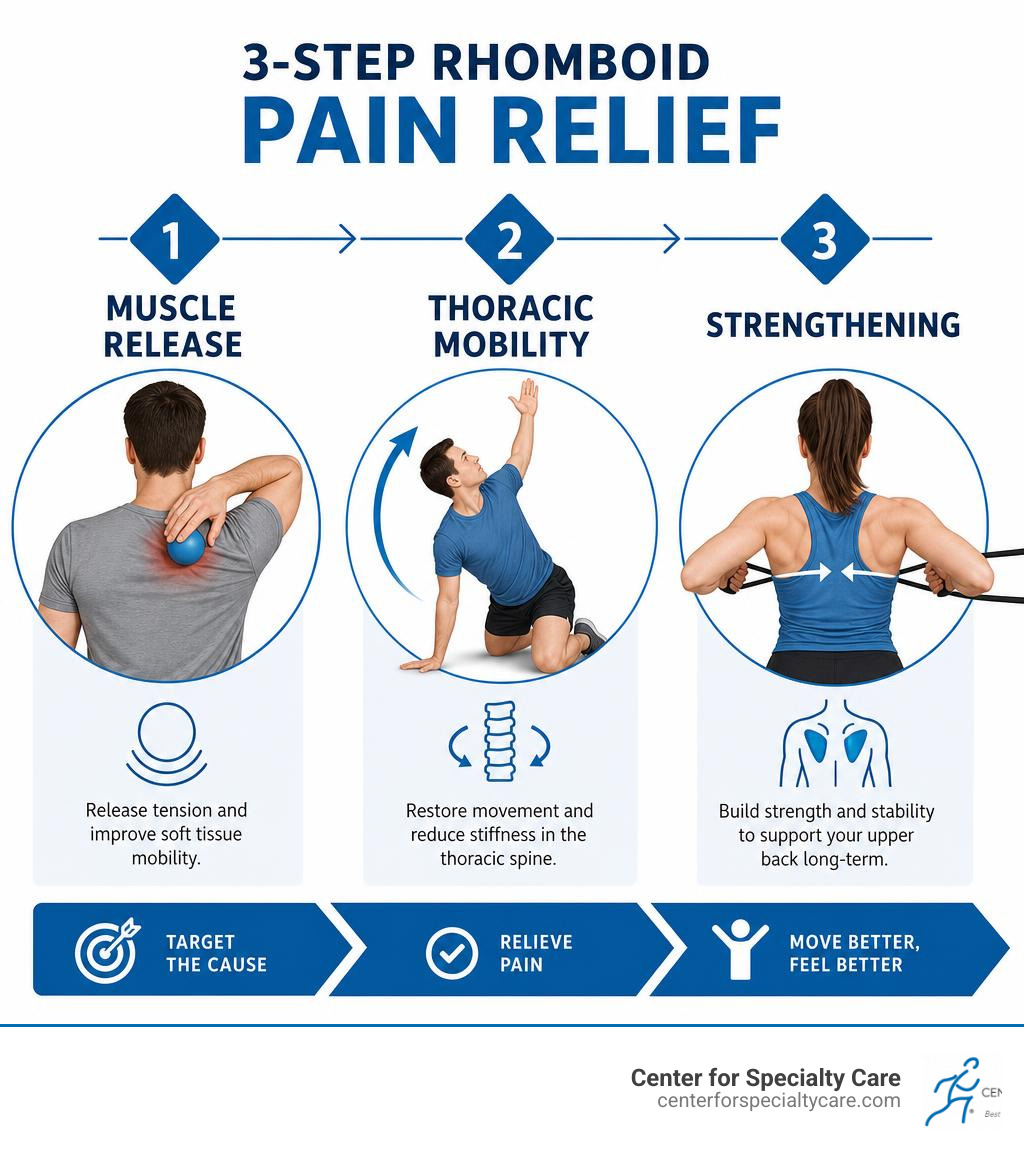
Quick look at rhomboid pain exercises:
Understanding Rhomboid Pain: Causes, Symptoms, and Diagnosis
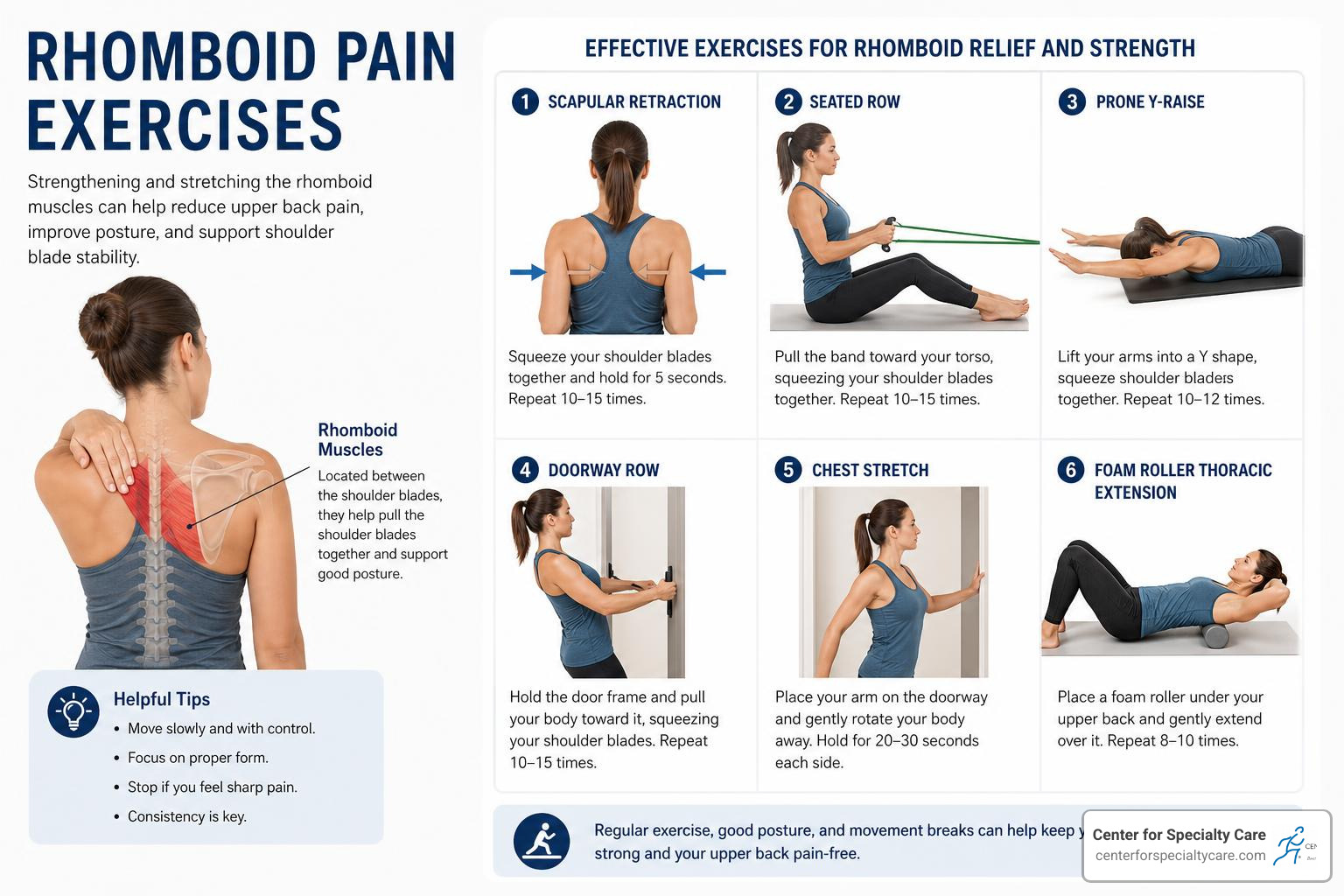
Your rhomboids are two pairs of muscles, the rhomboid major and rhomboid minor, located in your upper back between your spine and shoulder blades. Their main jobs are to pull the shoulder blades toward the spine, help stabilize the shoulder blades, and support posture during arm and shoulder movement.
When people say they have “rhomboid pain,” they usually mean pain near the inner edge of the shoulder blade. Sometimes it is a true rhomboid muscle strain. Other times, the pain is referred from the neck, ribs, shoulder joint, or surrounding muscles. That is why a smart exercise plan treats the whole upper back and neck area, not just one tight spot.
Common causes include:
- Poor posture, especially forward head posture
- Rounded shoulders or thoracic kyphosis
- Long periods of computer work or phone use
- Repetitive pulling, lifting, rowing, throwing, or overhead activity
- Sleeping in an awkward position
- Sudden strain from lifting something heavy
- Limited thoracic spine mobility
- Tight neck muscles, especially the levator scapulae and upper trapezius
- Cervical radiculopathy or nerve irritation from the neck
- Weakness in the shoulder blade stabilizing muscles
Poor posture is not a moral failure. It is usually just your body saying, “Hey, we have been in this chair for three hours. Maybe let us move?” Continuous computer work can increase sensitivity and strain in the upper trapezius, levator scapulae, and rhomboid region, which helps explain why desk workers often feel that familiar knot between the shoulder blades.
Common rhomboid pain symptoms include:
- Aching, burning, or tight pain between the shoulder blade and spine
- Tenderness along the inner border of the shoulder blade
- Muscle spasms or a “knot” sensation
- Pain that worsens with prolonged sitting or standing
- Discomfort when reaching, pulling, lifting, or rotating the neck
- Tightness in the upper back, neck, or shoulder
- Limited shoulder or neck range of motion
- Popping or grinding sensations around the shoulder blade
- Pain with deep breathing in some cases
For a deeper overview, read our guide to rhomboid muscle pain. You can also review medically oriented information on symptoms and causes from Scientific research on rhomboid symptoms.
Differentiating Rhomboid Pain from Neck and Shoulder Issues
Not every pain between the shoulder blades starts in the rhomboids. The cervical spine, upper ribs, shoulder joint, and nerves can all refer pain into this area. Cervical nerve irritation is especially sneaky because it can feel like a local muscle knot even when the neck is the main driver.
Use this comparison as a general guide:
| Feature | Rhomboid Muscle Strain | Cervical Referred Pain or Nerve Irritation |
|---|---|---|
| Pain location | More localized near inner shoulder blade | May spread from neck into shoulder blade, arm, or hand |
| Trigger | Lifting, pulling, sports, sudden strain | Neck position, prolonged screen time, looking down |
| Tender to touch | Usually yes | Sometimes, but not always |
| Neck symptoms | Mild or absent | Often stiffness, pain, tingling, numbness, or radiating symptoms |
| Arm symptoms | Usually no numbness or tingling | Possible numbness, tingling, weakness, or burning |
| Best first exercises | Gentle stretch, release, rows, scapular control | Neck mobility, chin tucks, thoracic mobility, nerve-sensitive modifications |
| When to get checked | Severe strain, swelling, persistent pain | Radiating pain, weakness, numbness, worsening symptoms |
You should seek medical care promptly if you have chest pain, shortness of breath, severe trauma, fever, unexplained weight loss, progressive arm weakness, numbness, loss of coordination, or pain that is severe and worsening.
If your “rhomboid knot” keeps coming back no matter how much you massage it, the neck or thoracic spine may be involved. Learn more in our article on a knot in the rhomboid.
The Ultimate 3-Step Protocol: Rhomboid Pain Exercises
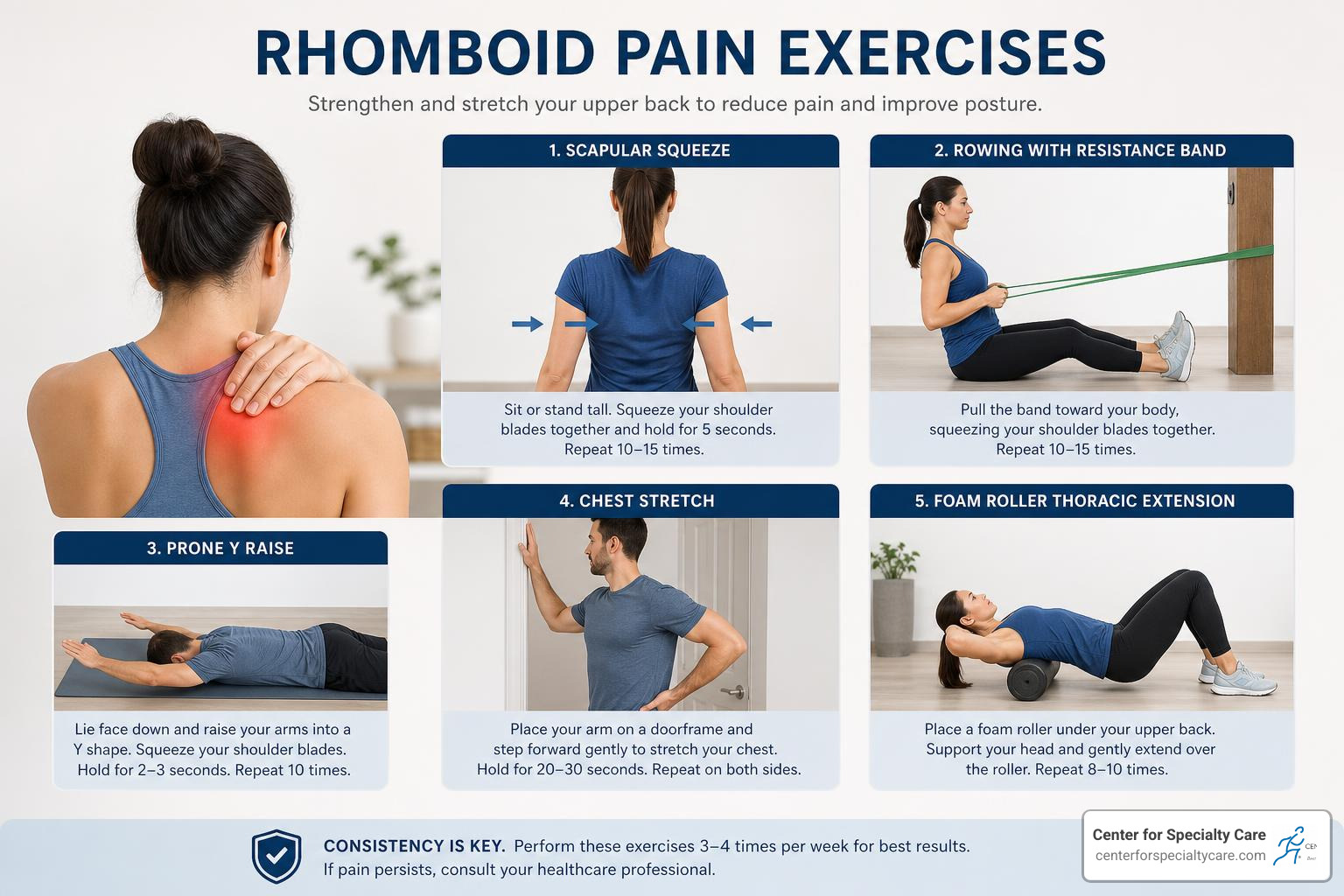
The best rhomboid pain exercises follow a simple sequence:
- Release muscle tension
- Restore neck and thoracic mobility
- Strengthen the shoulder blade stabilizers
This matters because pain relief is not just about making a tight muscle feel looser. It is about improving how the neck, upper back, ribs, and shoulder blades work together. Thoracic spine mobilization and exercise have been shown to reduce neck and shoulder pain severity and improve range of motion.
A helpful rehab exercise reference is available here: Scientific research on rhomboid rehab.
Step-by-Step Rhomboid Pain Exercises for Muscle Release
Start slowly. Mild stretching or muscle effort is okay. Sharp pain, numbness, tingling, or symptoms shooting down the arm are not “bonus points.” If that happens, stop and modify.
1. Rhomboid stretch
This is the classic lower neck and upper back stretch.
How to do it:
- Sit or stand tall.
- Reach both arms straight in front of you.
- Clasp your hands together.
- Gently reach forward as if you are rounding the upper back.
- Drop your chin toward your chest.
- Hold for 15 to 30 seconds.
- Repeat 2 to 4 times.
You should feel a gentle stretch between the shoulder blades and through the lower neck. Do not yank your arms forward or force your chin down.
2. Self-massage with a ball
This can reduce muscle guarding and help you find short-term relief before mobility work.
How to do it:
- Place a tennis ball or massage ball between your upper back and a wall.
- Position it beside the shoulder blade, not directly on the spine.
- Lean gently into the ball.
- Roll slowly until you find a tender spot.
- Hold gentle pressure for 30 to 60 seconds.
- Add small arm circles if comfortable.
- Repeat on the other side.
Important: Avoid pressing directly on the spine or shoulder blade bone. More pressure is not always better. Your goal is “good hurts,” not “why did I do this to myself?”
3. Neck stretch
This targets the side of the neck and upper shoulder area.
How to do it:
- Sit or stand upright.
- Relax both shoulders.
- Tilt your right ear toward your right shoulder.
- Do not raise the left shoulder.
- Hold for 15 to 30 seconds.
- Repeat on the left side.
- Do 2 to 4 rounds per side.
For a stronger but still gentle stretch, place the opposite hand behind your back. Avoid pulling hard on your head.
4. Neck rotation
Neck rotation helps when upper back pain is connected to cervical stiffness.
How to do it:
- Sit or stand tall.
- Keep your chin level.
- Slowly turn your head to the right.
- Hold for 15 to 30 seconds.
- Return to center.
- Turn to the left and hold.
- Repeat 2 to 4 times per side.
If holding increases symptoms, do 5 to 8 slow repetitions instead of a long hold.
5. Levator scapulae stretch
The levator scapulae runs from the neck to the shoulder blade and often contributes to shoulder blade discomfort.
How to do it:
- Sit tall.
- Turn your head about 45 degrees to the right.
- Look down toward your right armpit.
- Gently nod your chin downward.
- Hold 15 to 20 seconds.
- Repeat 2 to 3 times per side.
Keep the stretch gentle. If symptoms travel into your arm, stop.
Thoracic Mobility Exercises to Open the Mid Back
If the thoracic spine is stiff, the rhomboids may work overtime. These exercises help restore motion in the mid back.
6. Thoracic foam rolling
How to do it:
- Place a foam roller horizontally across your mid back.
- Support your head with your hands.
- Keep your hips on the floor or slightly lifted.
- Slowly roll from the bottom of the shoulder blades to the upper back.
- Pause 5 to 10 seconds on stiff areas.
- Continue for 1 to 2 minutes.
Do not roll aggressively over the neck or low back. The roller should be perpendicular to your spine, not lengthwise along it.
7. Open book rotations
How to do it:
- Lie on your side with knees bent.
- Stack your arms straight in front of your chest.
- Keep your knees together.
- Rotate your top arm open toward the floor behind you.
- Let your chest rotate, but do not force the shoulder down.
- Return slowly.
- Do 6 to 10 repetitions per side.
This exercise opens the chest, rotates the thoracic spine, and reduces the need for your neck and shoulder blade muscles to compensate.
8. Thread the needle
How to do it:
- Start on hands and knees.
- Slide your right arm under your left arm.
- Let your right shoulder and upper back rotate toward the floor.
- Pause for 2 to 3 seconds.
- Return to center.
- Repeat 6 to 10 times per side.
Move through a comfortable range. Keep your hips relatively steady.
9. T-spine opener or bench opener
How to do it:
- Kneel in front of a bench, chair, or couch.
- Place elbows on the surface.
- Sit your hips back slightly.
- Let your chest sink gently toward the floor.
- Keep your palms facing each other or upward.
- Hold 15 to 30 seconds.
- Repeat 2 to 4 times.
This is excellent for people who spend hours with arms forward at a keyboard.
Strengthening Rhomboid Pain Exercises for Long-Term Stability
Stretching may calm symptoms, but strengthening helps keep them from returning. The rhomboids often feel tight because they are irritated, overworked, or not sharing the load well with other shoulder blade muscles.
10. Resisted rows
How to do it:
- Secure a resistance band around a stable object at waist height.
- Hold one end in each hand.
- Stand tall with elbows bent about 90 degrees.
- Pull the band toward your ribs.
- Gently squeeze your shoulder blades together.
- Keep shoulders relaxed, not shrugged.
- Slowly return to start.
- Perform 8 to 12 repetitions.
Start with light resistance. If your neck tightens, reduce the band tension and focus on smooth motion.
11. Scapular squeezes
How to do it:
- Sit or stand tall.
- Let your arms rest by your sides.
- Gently pinch your shoulder blades together.
- Hold for 5 seconds.
- Relax completely.
- Repeat 10 to 15 times.
Do not jam the shoulder blades “down and back” as hard as possible. Think controlled squeeze, then full relaxation.
12. Banded pull aparts
How to do it:
- Hold a light resistance band in front of your chest.
- Keep elbows mostly straight.
- Pull the band apart until your hands move toward shoulder level.
- Squeeze gently between the shoulder blades.
- Return slowly.
- Do 2 sets of 8 to 12 reps.
This strengthens the upper back and helps counter rounded shoulder posture.
13. Banded scapular angel
How to do it:
- Hold a light band with both hands.
- Stand tall with ribs down and chin gently tucked.
- Move your arms upward and outward like making a snow angel.
- Keep the neck relaxed.
- Return slowly.
- Do 2 sets of 6 to 8 reps.
This trains shoulder blade coordination, not just strength.
14. Prone lateral raise
How to do it:
- Lie face down on a mat or firm surface.
- Extend arms out to the sides in a “T” position.
- Keep thumbs pointing slightly upward.
- Lift arms a few inches.
- Squeeze shoulder blades gently.
- Lower slowly.
- Do 1 to 2 sets of 8 to 10 reps.
Use no weight at first. Add light weights only when the movement is pain-free.
For more shoulder and upper back options, explore our guide to exercises for shoulder pain.
Designing Your Routine: How Often to Do Rhomboid Pain Exercises
The right routine depends on whether your pain is acute, chronic, mild, or severe. As a general rule, mobility work can be done more often than strengthening.
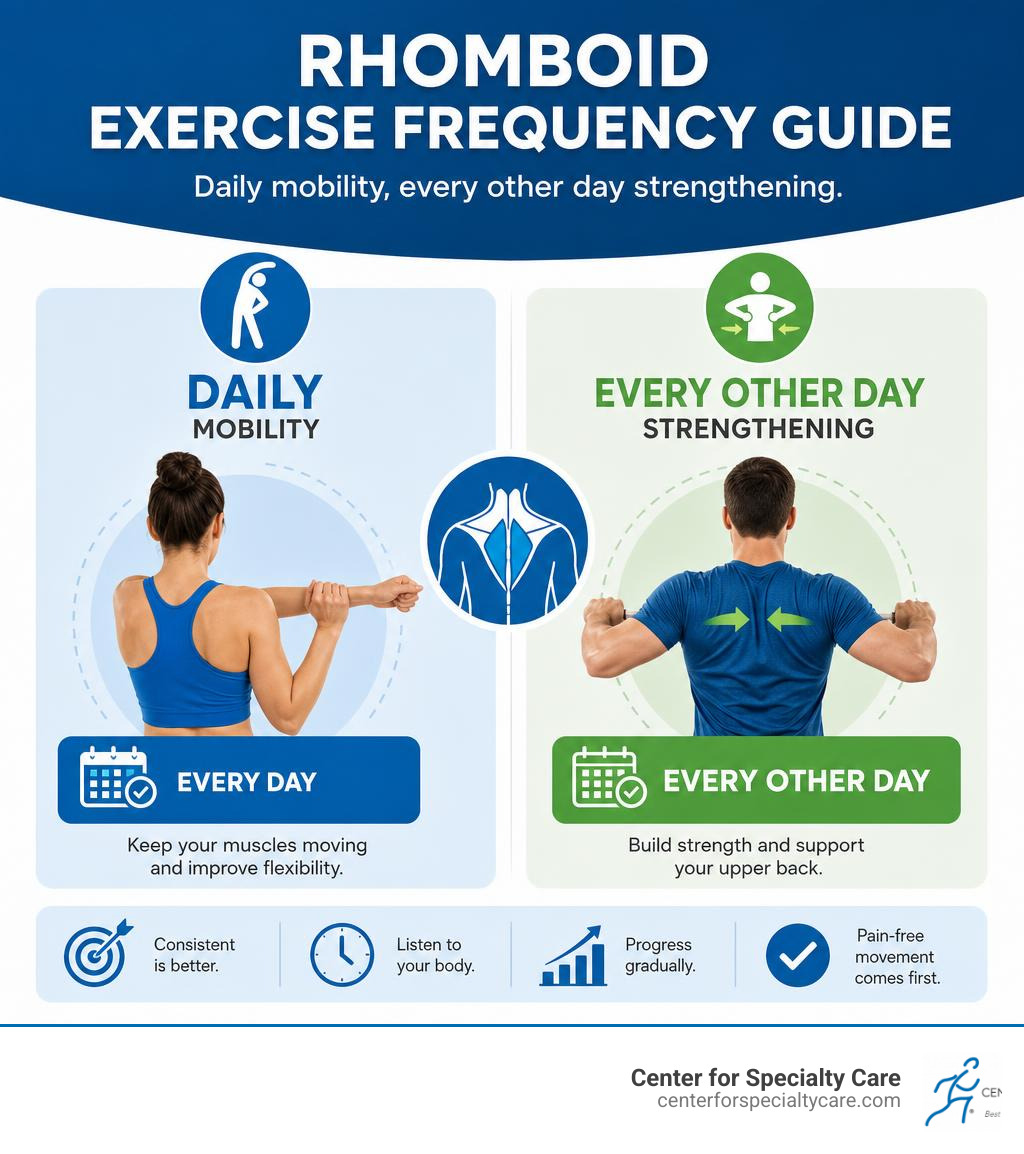
A simple starting plan:
| Exercise Type | Frequency | Duration or Sets |
|---|---|---|
| Rhomboid stretch | Daily | 2 to 4 holds of 15 to 30 seconds |
| Neck stretches and rotations | Daily, 1 to 3 times | 2 to 4 holds per side |
| Self-massage with ball | Daily or as needed | 30 to 60 seconds per tender spot |
| Thoracic mobility | Daily | 5 to 10 slow reps or 1 to 2 minutes |
| Strengthening exercises | Every other day | 1 to 3 sets of 6 to 12 reps |
Beginner modification:
- Start with 5 minutes per day.
- Pick 1 release exercise, 1 mobility exercise, and 1 strengthening exercise.
- Use light resistance or body weight.
- Keep effort at about 3 to 5 out of 10.
- Stop if pain increases and stays worse after exercise.
For severe pain:
- Avoid heavy rows, aggressive stretching, and deep ball pressure.
- Use heat or ice first if needed.
- Focus on gentle breathing, neck range of motion, and short walks.
- Consider a professional evaluation before starting resistance work.
Pain versus discomfort:
- Acceptable: mild stretch, gentle muscle work, temporary soreness.
- Not acceptable: sharp pain, symptoms down the arm, numbness, tingling, weakness, dizziness, or pain that worsens for hours afterward.
Progression guidelines:
- Week 1: Gentle release and mobility.
- Week 2: Add light scapular squeezes and rows.
- Weeks 3 to 4: Increase resistance or sets if symptoms are improving.
- Beyond 4 weeks: Build full upper back, shoulder, and core strength.
If symptoms are not improving, read our ultimate rhomboid muscle strain recovery plan or schedule a clinical evaluation.
Complementary Treatments and Lifestyle Changes
Exercises work best when your daily habits stop feeding the problem. We are not asking you to sit like a statue with perfect posture. Actually, there is no single perfect posture. The best posture is usually the next posture.
Helpful lifestyle changes include:
- Take movement breaks every 30 to 60 minutes.
- Keep screens at eye level when possible.
- Keep elbows supported during desk work.
- Avoid holding your phone between your ear and shoulder.
- Use a chair that supports your mid back.
- Change positions throughout the day.
- Use a backpack on both shoulders instead of one.
- Warm up before lifting, sports, or yard work.
- Improve sleep position with supportive pillows.
- Manage stress, since stress often increases neck and upper back tension.
Heat and cold can help too:
- Use cold therapy for a recent strain or sharp flare-up, usually 15 to 20 minutes at a time.
- Use heat for chronic tightness or stiffness, usually 15 to 20 minutes.
- Some people do best alternating heat and cold.
Other helpful treatments may include physical therapy, guided strengthening, manual therapy, medication guidance, injections when appropriate, or evaluation for neck and shoulder conditions. At Center for Specialty Care, we offer both non-surgical and surgical orthopedic options when needed, but most rhomboid-related pain starts with conservative care.
To learn more, visit our physical therapy page. If your pain involves the shoulder joint or movement limitations, our team can also help with shoulder treatment with physical therapy recovery pain relief.
Frequently Asked Questions about Rhomboid Pain
How do I know if my pain is from the rhomboid or my neck?
Rhomboid pain is often local, tender to touch, and triggered by pulling, lifting, reaching, or direct strain. Neck-related referred pain may change when you move your neck, look down, rotate your head, or sit at a screen for a long time.
Signs your neck may be involved include:
- Pain that starts in the neck and travels to the shoulder blade
- Tingling, numbness, or burning into the arm or hand
- Weakness or loss of grip strength
- Pain that changes with neck position
- Headaches with upper back tension
If you are unsure, do not guess for months while becoming best friends with a tennis ball. A professional exam can check range of motion, nerve signs, shoulder mechanics, and muscle strength. Read our complete guide to relieving rhomboid pain for more detail.
Can I use a foam roller directly on my rhomboids?
Yes, but with good technique. Place the foam roller horizontally across your upper or mid back, perpendicular to your spine. Roll slowly from the lower shoulder blade area toward the upper back. Pause on stiff areas, but avoid aggressive pressure directly on the spine, neck, or shoulder blade bones.
For more targeted pressure, use a tennis ball or massage ball against a wall instead of lying with full body weight on it. That gives you more control.
Foam rolling may reduce muscle tension temporarily, but it should be paired with thoracic mobility and strengthening. Rolling alone often feels good but does not fix the underlying movement problem.
How long does it take for a rhomboid strain to heal?
Mild rhomboid strains often improve within a few weeks with rest, gentle movement, and progressive exercise. More significant strains can take several months, especially if you keep aggravating the area with heavy lifting, poor sleep position, or prolonged static posture.
A rough timeline:
- Mild irritation: a few days to 2 weeks
- Mild strain: about 2 to 3 weeks
- Moderate strain: 4 to 8 weeks
- Severe strain or recurring pain: several months and may need evaluation
Healing is faster when you avoid the “too much, too soon” trap. Increase activity gradually and pay attention to symptoms the next day. For rehab planning, see our tips for shoulder treatment physical therapy tips for fast recovery.
Conclusion
Rhomboid pain can feel stubborn, but it usually responds well to the right plan. The key is to stop treating it as only a tight muscle. The most effective rhomboid pain exercises combine muscle release, neck and thoracic mobility, and shoulder blade strengthening.
Start with the basics:
- Release the tight area gently.
- Restore motion in the neck and mid back.
- Strengthen the rhomboids and surrounding shoulder blade muscles.
- Improve daily habits that keep irritating the area.
- Get help if pain persists, worsens, or radiates.
At Center for Specialty Care, we provide personalized orthopedic and pain management care for patients in Fairmont, MN, Estherville, IA, Buffalo Center, IA, St. James, MN, and surrounding Minnesota and Iowa communities. Our goal is simple: help you move better, hurt less, and get answers quickly.
If that shoulder blade pain is not going away, we are here to help. Schedule a consultation for back pain relief.