
Stomach Sleeper Problems: How to Stop Shoulder Pain in Your Sleep
July 24, 2026
Relieving the Pressure with Thigh Fasciotomy
July 29, 2026
No Prescription Needed: Best Over the Counter Orthotics for Flat Feet
Why Finding the Best Over the Counter Orthotics for Flat Feet Matters
Finding the best over the counter orthotics for flat feet can quickly relieve nagging pain in your arches, knees, and lower back.
If you want a fast answer, here is a quick summary of the top-rated non-prescription insoles:
- Best Overall Support: PowerStep Pinnacle Maxx Support (excellent stability and overpronation control).
- Best Low-Profile Fit: Superfeet All-Purpose Support Low Arch (firm support that fits easily into tight or dress shoes).
- Best Customizable Option: Spenco RX Custom Arch (features a remoldable arch plate for a personalized fit).
- Best Budget Option: Dr. Scholl’s Stability Support (solid everyday alignment for under $20).
To get the best results, look for insoles with firm arch support and a deep heel cup rather than soft, pillowy gel inserts that collapse under your weight.
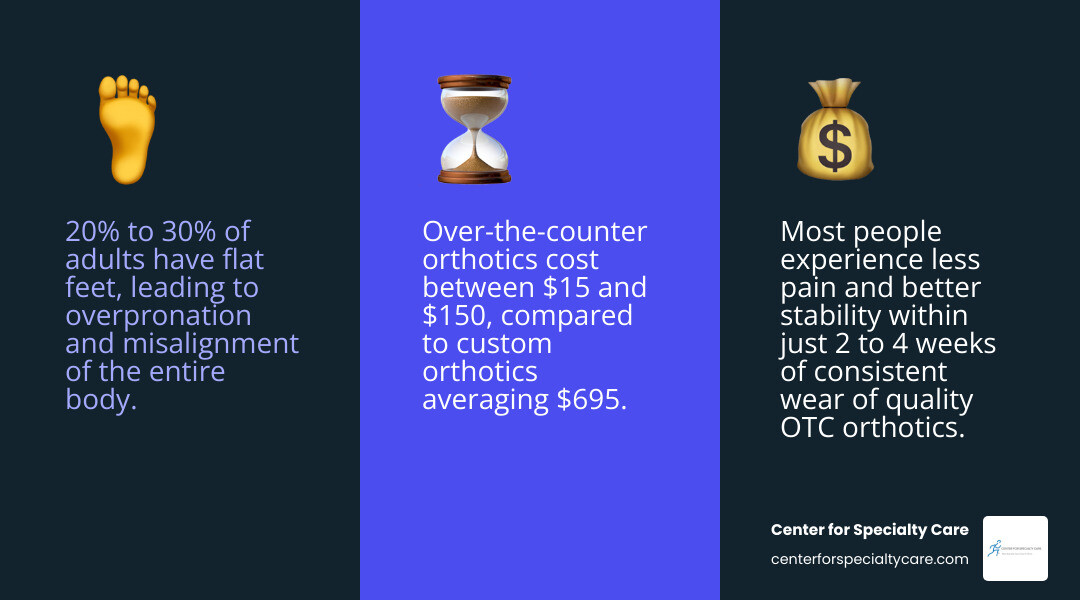
About 20% to 30% of adults have flat feet. When your arches collapse, your ankles roll inward. This is called overpronation, and it throws your whole body out of alignment.
Quality over-the-counter options cost between $15 and $150, which is much cheaper than custom orthotics that average $695. Most people experience less pain and better stability within just two to four weeks of consistent wear.
As an orthopedic surgeon at the Center for Specialty Care, I, Dr. Corey Welchlin, have spent over three decades helping patients select the best over the counter orthotics for flat feet to get back to their active lifestyles. In my clinical experience, choosing the right support leads to positive outcomes and lasting relief in about 90% of cases.
Quick best over the counter orthotics for flat feet definitions:
Understanding Flat Feet and the Need for Support
To choose the right insole, we first need to look at how your feet behave under pressure. Flat feet, or fallen arches, occur when the entire sole of your foot makes contact with the ground while standing. While some people are born with flat feet, others develop them over time due to wear and tear, pregnancy, or injuries.
There is a major difference in how we support the two primary types of flat feet:
- Flexible Flat Feet: If you sit down, lift your foot, and see a visible arch, but that arch completely disappears the moment you stand up and bear weight, you have flexible flat feet.
- Rigid Flat Feet: If your foot remains completely flat whether you are sitting, standing, or lifting your leg, you have rigid flat feet.
Understanding this distinction is critical. If you have flexible flat feet, your tendons and ligaments are highly mobile, meaning a structured insole can help guide your foot back into alignment. If you have rigid flat feet, forcing a high, unyielding arch support under your foot will only cause painful pressure points. Instead, you need a low-profile, supportive surface that redistributes pressure evenly.
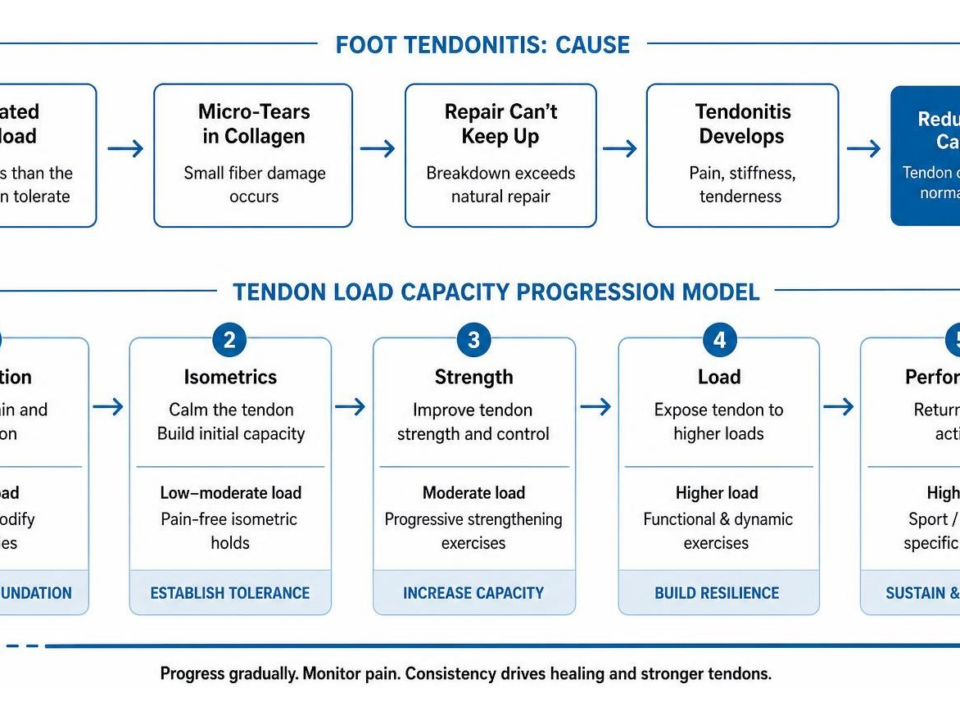
When your arch collapses, it places immense strain on your posterior tibial tendon—the main tendon supporting your arch. To understand how these structures interact, read our detailed breakdown on Everything You Need to Know About Foot Tendons.
Furthermore, this structural collapse causes your ankles to roll inward (overpronation). This inward twist travels up your leg, misaligning your knees, hips, and lower back. By utilizing proper The Complete Guide to Flat Foot Arch Support, you can stop this painful chain reaction before it impacts your daily mobility.
How to Choose the Best Over the Counter Orthotics for Flat Feet
Many people make the mistake of walking into a pharmacy and buying the softest, most cushioned gel inserts they can find. While gel feels comfortable for the first five minutes, it does nothing to correct your alignment.
When shopping for the best over the counter orthotics for flat feet, we advise focusing on three key elements:
- Arch Height: People with flat feet generally require a low to medium arch profile. A high arch insert will feel like you are standing on a hard tennis ball, leading to secondary foot pain.
- Heel Cup Depth: A deep heel cup is essential. It cradles your heel bone (calcaneus), concentrating your foot’s natural protective fatty pad directly under your heel while preventing your ankle from rolling inward.
- Firmness: Look for semi-rigid or firm structural support. A quality insole should act like a spring—flexing slightly under your weight to absorb shock, but immediately returning to its shape to support your skeletal structure.
To help you visualize what to look for, here is a quick comparison of arch support features:
| Feature | Low Arch Support (Best for Flat Feet) | Medium Arch Support | High Arch Support |
|---|---|---|---|
| Primary Goal | Realignment & overpronation control | General stability & comfort | Shock absorption for rigid arches |
| Arch Profile | Low, gradual slope | Moderate curve | Steep, high curve |
| Flexibility | Semi-rigid to rigid | Moderate flex | Highly flexible to firm |
| Best For | Rigid/flexible flat feet, severe overpronation | Mild flat feet, neutral arches | High arches, supination |
Key Features of the Best Over the Counter Orthotics for Flat Feet
If you suffer from moderate to severe overpronation, look for orthotics that feature medial posting. A medial post is a slightly firmer, raised wedge built into the inner side of the heel and arch area. This structural wedge physically blocks your heel from rolling too far inward during your gait cycle.
Additionally, look for multi-density construction. This combines shock-absorbing materials (like polyurethane or specialized EVA foams) on the top layer with a rigid thermoplastic stabilizer cap on the bottom.
For men who struggle with severe ankle rolling, products like the Men’s Overpronation Orthotics for Support & Pain Relief | Aetrex provide built-in medial posting and rearfoot control to stabilize the heel and protect the plantar fascia from excessive stretching.
Top Product Recommendations for the Best Over the Counter Orthotics for Flat Feet
Here are the top-performing, non-prescription orthotics designed specifically to address flat feet and overpronation:
1. PowerStep Pinnacle Maxx Support
This is widely considered the gold standard for overpronation control. It features a firmer shell than the standard PowerStep models, alongside a squared heel design with a built-in medial post to prevent the ankle from rolling inward.
- Best For: Moderate to severe overpronation and flexible flat feet.
- Key Features: Double-layer shock-absorbing cushioning, deep heel cradle, and medical-grade support.
- Where to Buy: Powerstep Pinnacle Maxx Full Length Orthotic Insoles.
2. Superfeet All-Purpose Support Low Arch (Formerly Superfeet Black)
Superfeet is famous for its rigid stabilizer caps. This low-profile, highly durable insole is thin enough to fit into tight-fitting footwear, including dress shoes, casual loafers, and slim athletic cleats, without crowding your toes.
- Best For: Rigid flat feet and low-volume footwear.
- Key Features: High-density foam, low arch profile, and a thin, lightweight stabilizer cap.
- Where to Buy: All-Purpose Support Low Arch: Low Profile Insoles for Flat Feet | Superfeet.
3. Spenco RX Custom Arch Orthotic Insole
If you want a custom feel without the custom price tag, this 3/4-length insert is a fantastic choice. It features a moldable arch plate that can be adjusted to match the exact contours of your foot. Because it is 3/4-length, it ends right before the ball of your foot, preventing toe crowding.
- Best For: Individuals looking for personalized, adjustable support.
- Key Features: Remoldable arch plate, SpenCore shock absorption, and a low-friction top cover.
- Where to Buy: RX Custom Arch Orthotic Insole – Spenco US.
4. Spenco Total Support Original Insole
For those with mild flat feet who need a balance of cushioning and structural stability, this insole offers medium arch support. It features a deep heel cup and a unique big-toe cutout that encourages natural arch engagement.
- Best For: Multi-sport use, running, and all-day walking.
- Key Features: Multi-density cushioning, metatarsal dome, and APMA Seal of Acceptance.
- Where to Buy: Spenco Total Support Original Insole.
5. Slim Orthotic Stabilizer by Natural Foot Orthotics
This semi-rigid, 3/4-length stabilizer is designed to target the root cause of flat foot pain by supporting all four arches of the foot. It is exceptionally low-profile, making it highly versatile across casual, athletic, and work footwear.
- Best For: Postural alignment and chronic heel pain.
- Key Features: Semi-rigid design, 3/4 length, and HSA/FSA eligibility.
- Where to Buy: Slim Orthotic: Low to Flat Arch Support Inserts – Natural Foot Orthotics.
When to Transition from OTC Insoles to Custom Orthotics
While high-quality over-the-counter insoles resolve foot fatigue and alignment issues for the vast majority of our patients, they do have limitations. OTC options are designed for symmetrical, average foot shapes. If you have a severe structural deformity, a history of recurring stress fractures, or diabetic neuropathy, generic insoles may not provide the precise correction you need.
You should consider transitioning to a custom-molded medical orthotic or advanced orthopedic support if you experience any of the following:
- Severe, sharp pain that does not improve after 4 weeks of wearing quality OTC insoles.
- Progressive flattening of only one foot (which can indicate a failing posterior tibial tendon).
- An inability to perform a single heel raise (standing on one foot and lifting your heel off the ground).
- Significant structural differences between your left and right foot.
When conservative insoles are not enough to manage severe joint instability or tendon weakness, we often utilize specialized clinical supports. For example, the Orthosis With Stepless Knob 3 Point Stability Gray Fits Right provides targeted, adjustable pressure to stabilize compromised joints.
If you are dealing with severe overpronation that affects your ankle stability during high-impact activities, pairing your orthotics with a structured brace like the Ultra Ankle 360 Adjustable Support Brace Lace Up can help prevent painful ankle rolling and keep you moving safely.
Frequently Asked Questions About Flat Foot Insoles
Do over-the-counter orthotics really work for flat feet?
Yes, clinical evidence and real-world outcomes show that high-quality, firm OTC orthotics are highly effective. While they do not permanently change your bone structure or “cure” flat feet, they correct your gait, prevent overpronation, distribute pressure evenly across your sole, and relieve strain on your tendons. About 90% of patients with mild to moderate flat feet find significant relief within 2 to 4 weeks of consistent wear.
How long do over-the-counter orthotics last?
A high-quality pair of over-the-counter orthotics typically provides reliable support for 6 to 12 months of regular daily use. Cheap, drug-store foam inserts often lose their cushioning within a few weeks. To maximize the lifespan of your orthotics, we recommend removing them from your shoes weekly to spot-clean them with mild soap and a damp cloth, allowing them to air dry completely.
Can flat feet insoles help with knee and back pain?
Absolutely. Your feet are the foundation of your entire body. When your arches collapse and your ankles roll inward, it forces your tibia (shin bone) and femur (thigh bone) to rotate inward as well. This rotation places abnormal lateral stress on your knee joints and tilts your pelvis forward, leading to chronic lower back strain. By stabilizing your arches, you realign your entire kinetic chain and reduce joint stress.
Conclusion
Living with flat feet doesn’t mean you have to accept daily foot fatigue, knee aches, or lower back stiffness. With the best over the counter orthotics for flat feet, you can quickly restore proper alignment, protect your joints, and enjoy your favorite activities pain-free.
At the Center for Specialty Care, we are dedicated to helping our patients find the right path to pain relief. Whether you need guidance selecting the perfect over-the-counter insert, physical therapy to strengthen your arches, or a comprehensive evaluation for custom orthotics, our team is here to help. We proudly serve our neighbors across Minnesota and Iowa with locations in:
- Fairmont, MN
- Estherville, IA
- St. James, MN
- Buffalo Center, IA
We pride ourselves on our personalized care, 100% patient satisfaction, and quick appointment availability so you can get the answers you need without the wait.
Are you ready to take the first step toward pain-free walking? Schedule a Podiatry Consultation with us today, and let’s get you back on your feet!