Relieving the Pressure with Thigh Fasciotomy
July 29, 2026
Protecting Your Practice: A Guide to Foot Tendon Malpractice Insurance
July 31, 2026
Step Pain-Free Again: The Best Foot Tendonitis Relief Options
When Every Step Hurts: Understanding Foot Tendonitis Relief
Foot tendonitis relief starts with understanding what you’re dealing with — and acting on it quickly.
Here are the most effective ways to relieve foot tendonitis pain:
- Rest the foot and stop activities that cause pain
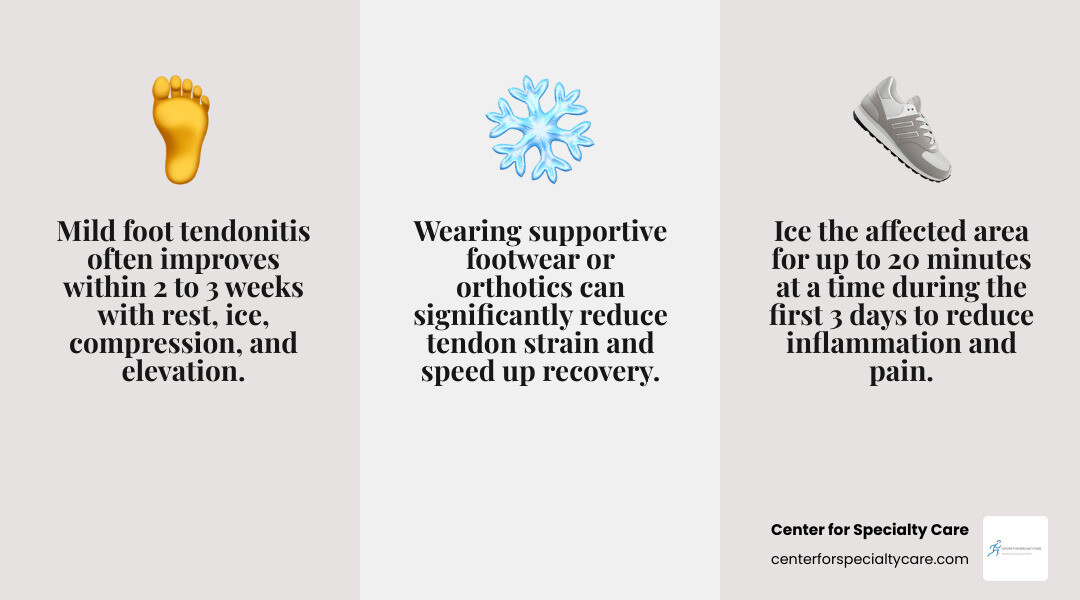
- Ice the area for up to 20 minutes at a time during the first 3 days
- Compress with an elastic bandage to reduce swelling
- Elevate your foot above heart level to limit fluid buildup
- Take NSAIDs like ibuprofen to reduce pain and inflammation
- Wear supportive footwear or orthotics to reduce tendon strain
- Stretch gently — especially the calf — to relieve tension
- See a doctor if pain persists beyond 2 to 3 weeks
Mild cases often improve within 2 to 3 weeks with home care. More stubborn cases may take a few months of conservative treatment. If nothing works after 6 months, surgical options exist — but most people never get there.
Foot tendonitis is inflammation in one or more of the tendons in your foot. It’s usually caused by overuse, and it can make even simple tasks — like walking to your car or climbing stairs — feel like a real challenge. The pain tends to build gradually, and many people try to push through it, which often makes things worse.
I’m Dr. Corey Welchlin, a board-certified orthopedic surgeon with over 30 years of experience treating musculoskeletal conditions, including foot tendonitis relief for patients across southern Minnesota and northern Iowa. In this guide, I’ll walk you through everything you need to know — from recognizing the symptoms to choosing the right treatment path.
Foot tendonitis relief terms made easy:
Understanding Foot Tendonitis: Types, Causes, and Symptoms
A tendon is a thick, fibrous cord of highly organized connective tissue that attaches muscle to bone. Think of tendons as the heavy-duty cables that transmit the force of your muscles to make your bones move. When these cables are subjected to sudden, sharp movements or repetitive strain, they can develop tiny micro-tears. When this happens, the body triggers an inflammatory response. This is tendonitis.
While an acute strain can happen in a split second — like when you misstep on an uneven gravel road or a slick patches of ice during a Midwest winter — most foot tendonitis is a chronic wear-and-tear issue. Over time, repetitive stress outpaces your body’s ability to repair the tendon, leading to persistent discomfort, swelling, and stiffness. To dive deeper into the clinical breakdown of this condition, you can read the Cleveland Clinic’s guide on foot tendonitis.
Common Types of Foot Tendonitis
Your foot contains several key tendons that keep you moving, and any one of them can become inflamed. To understand which one is causing your pain, it helps to look at the anatomy:
- Achilles Tendonitis: The Achilles tendon is the thickest and strongest tendon in the human body, connecting your calf muscles to your heel bone. It takes a massive beating during activities like running, jumping, and walking. Achilles tendonitis affects anywhere from 1% to 9% of elite and recreational athletes.
- Peroneal Tendonitis: The peroneal tendons run side-by-side behind your outer ankle bone. They help stabilize your foot and protect you from rolling your ankle. When these get inflamed, you will feel pain on the outside of your ankle and foot.
- Extensor Tendonitis: These tendons run along the top of your foot and allow you to pull your toes upward. If you lace your shoes too tightly or spend a lot of time walking uphill, these can easily become irritated.
- Posterior Tibial Tendonitis: This tendon attaches the calf muscle to the bones on the inside of your foot, playing a massive role in supporting your foot’s natural arch.
To learn more about how these structures operate together, explore our articles on foot tendons explained and get everything you need to know about foot tendons.
Causes and Risk Factors
Why do some people develop foot tendonitis while others walk away pain-free? It usually comes down to a combination of mechanical alignment, lifestyle choices, and everyday habits.
- Structural Foot Abnormalities: Having flat feet or high arches changes the way weight is distributed across your feet. Flat feet, for example, cause the arch to collapse inward, putting immense, unnatural strain on the posterior tibial tendon.
- Tight Calf Muscles: If your calves are tight, they pull constantly on your Achilles tendon, reducing its flexibility and making it highly susceptible to micro-tears during basic movements.
- Repetitive Strain: Sudden spikes in physical activity — like starting a high-impact running routine without proper conditioning — are prime culprits.
- Aging Tendons: As we age, our tendons naturally lose their elasticity and become more brittle, making them easier to injure.
- Tobacco Use: Smoking impairs circulation and reduces the delivery of oxygen and vital nutrients to your tendons, which drastically slows down the healing process.
- Body Weight: Carrying extra weight increases the mechanical load placed on your foot tendons with every single step.
Top Conservative Options for Foot Tendonitis Relief
Fortunately, the vast majority of people recover fully from foot tendonitis without any permanent damage. Standard, conservative treatments are highly effective and can heal most mild tendon injuries within a few weeks to a few months.
The RICE Protocol and Temperature Therapy
If you have recently injured your foot or are experiencing a painful flare-up, your first line of defense is the classic RICE protocol:
- Rest: Stop high-impact physical activities. Rest and stay off your feet as much as possible for a few days to weeks to give the damaged fibers a chance to knit back together.
- Ice: Apply cold packs wrapped in a thin towel to the painful area for 10 to 15 minutes several times a day. Do this for the first 3 days to bring down acute swelling.
- Compression: Wrap your foot snugly (but not too tightly) with an elastic bandage or wear a soft brace during the day to prevent fluid buildup. Always remove the bandage or brace before going to bed to ensure healthy circulation.
- Elevation: Whenever you are sitting or resting, prop your foot up on pillows so that it rests above the level of your heart.
When it comes to temperature therapy, timing is everything. Use ice during the first 3 days of an acute flare-up. If your pain has persisted for 3 days or more and has transitioned into a chronic ache, switch to heat. Applying a heating pad or a warm towel for 20 to 30 minutes, 2 to 3 times a day, helps relax tight muscles and boosts blood flow to speed up tissue repair.
To understand how to apply this to specific areas, read about peroneal tendonitis heat or ice and find out is heat good for peroneal tendonitis.
| Therapy Type | Best Time to Use | Duration | Primary Benefit |
|---|---|---|---|
| Ice Therapy | First 1 to 3 days of injury or acute flare-up | 10 to 15 minutes, several times a day | Reduces acute swelling and numbs sharp pain |
| Heat Therapy | After 3 days of persistent, chronic pain | 20 to 30 minutes, 2 to 3 times a day | Relaxes tight tissues and increases healing blood flow |
Supportive Footwear and Orthotics
The shoes you wear can either be your foot’s best friend or its worst enemy. Worn-out shoes or footwear that lacks proper structural support can force your foot into unnatural angles, putting excessive strain on your tendons.
If you struggle with flat feet or high arches, custom orthotics or high-quality over-the-counter shoe inserts can make a world of difference. They redistribute weight evenly across your foot, correct biomechanical imbalances, and take the direct physical load off your healing tendons. This is especially true for the top of the foot; learn more about this by reading our guide on extensor tendonitis recovery.
Stretches and Exercises for Foot Tendonitis Relief
Once the initial sharp pain begins to subside, keeping your foot completely still can actually cause joint stiffness and muscle weakness. Gentle movement is key to a full recovery.
- Calf Stretches: Keeping your calves loose is one of the most effective ways to relieve tension on your Achilles tendon. Try standing facing a wall, extending one leg straight back with your heel flat on the floor, and leaning forward until you feel a gentle stretch.
- Eccentric Loading: This involves slowly lowering your heel off the edge of a step, which strengthens the tendon as it lengthens.
- Low-Impact Exercise: Swap high-impact activities like running or aerobics for low-impact alternatives like swimming or cycling. These keep your cardiovascular health in top shape without pounding your recovering foot.
For more expert insights on rebuilding tendon strength safely, check out our guide on Achilles tendonitis 101.
Professional Medical Treatments and Recovery Timelines
If your foot pain does not improve after 2 to 3 weeks of dedicated at-home care, it is time to seek professional medical help.
When to Seek Professional Foot Tendonitis Relief
You should schedule an appointment with an orthopedic specialist if you experience:
- Severe swelling, redness, or heat around the tendon.
- An inability to bear weight on your foot.
- Pain that wakes you up at night or persists despite resting.
- A “popping” or “snapping” sound accompanied by sudden, severe pain.
To explore when it is time to step up your care, take a look at our article on stepping up to foot tendonitis.
Advanced Non-Surgical and Surgical Interventions
When you visit us, we will perform a thorough physical exam and may use advanced diagnostic tools. While X-rays can help us rule out bone fractures, ultrasound is often our diagnostic tool of choice for non-torn tendons. It allows us to observe the tendon’s movement in real-time and identify areas of degeneration.
If conservative treatments fail to provide foot tendonitis relief after 6 months, we may discuss more advanced options:
- TenJet (Ultrasound-Guided Hydroresection): This is a state-of-the-art, minimally invasive, office-based procedure. It uses a high-velocity stream of saline to precisely debride and remove damaged, degenerative tendon tissue (tendinosis) without harming the surrounding healthy tissue.
- Gastrocnemius Recession: A surgical procedure to lengthen the calf muscles, reducing the chronic pull and strain on the Achilles tendon.
- Tenosynovectomy: A procedure to clean away inflamed, damaged tissue surrounding the tendon sheath.
- Tendon Transfer: In severe cases where a tendon is heavily damaged or ruptured, a healthy tendon from another part of the foot may be moved to restore function.
While conservative treatments usually heal a mild injury in a few weeks, surgical recovery is a longer journey, typically taking anywhere from 6 to 12 months for a complete return to full physical activity.
Frequently Asked Questions About Foot Tendonitis
Can foot tendonitis lead to a complete tendon rupture?
Yes. If you ignore the warning signs of chronic tendonitis and continue to push through severe pain, the tendon fibers can weaken to the point of a complete rupture. A tendon rupture is often accompanied by a distinct popping or snapping sound, immediate severe pain, and an inability to point your foot downward or walk. This is a medical emergency that often requires surgical repair.
How long does it take to recover from foot tendonitis?
A mild tendon injury treated quickly at home should feel significantly better within 2 to 3 weeks. Chronic cases treated with conservative therapies like custom orthotics and physical therapy typically heal within a few months. However, if your condition requires surgery, you should expect a recovery period of 6 to 12 months.
Is heat or ice better for peroneal tendonitis?
During the acute phase (the first 72 hours of pain or after a sudden strain), ice is best to control inflammation and numb the pain. For chronic, lingering stiffness and pain that has lasted for more than 3 days, heat is better because it stimulates blood flow and relaxes the surrounding muscles.
Conclusion
You do not have to live with chronic foot pain or let tendonitis limit your active lifestyle. At the Center for Specialty Care, we are dedicated to helping you step pain-free again. With convenient clinic locations in Fairmont, MN, Estherville, IA, Buffalo Center, IA, and St. James, MN, we serve patients throughout southern Minnesota and northern Iowa with personalized, compassionate orthopedic care.
Our ultimate goal is 100% patient satisfaction. We offer quick appointment availability so you can get the answers and relief you need without the wait, whether you require non-surgical therapies or advanced surgical care.
Ready to take the first step toward lasting foot tendonitis relief? Contact us today to schedule your consultation, or explore Center for Specialty Care’s pain management services to learn more about how we can help you get back on your feet.