Put Your Best Foot Forward with Osteopathic Manipulation for Tendon Pain
July 9, 2026
When Acid Reflux Backs Up Into Your Back
July 11, 2026
Ouch, My Shoulder Blades! A Guide to Rhomboid Strain Symptoms
That Pain Between Your Shoulder Blades Might Be a Rhomboid Strain
Rhomboid strain symptoms are easy to miss at first — but they can stop you in your tracks fast.
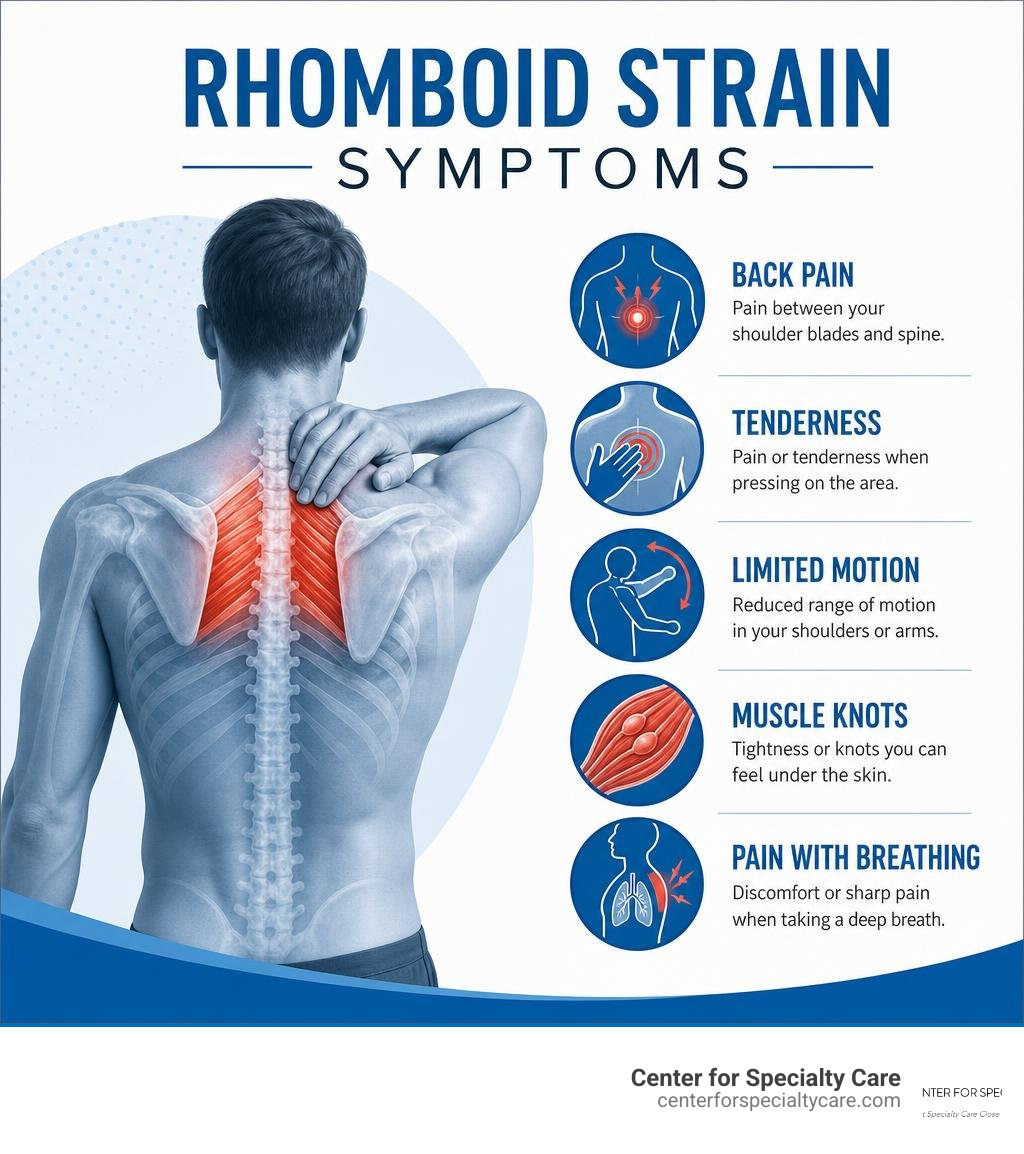
Here’s a quick look at the most common signs:
- Pain between your shoulder blades and spine — often dull, aching, or burning
- Tenderness when pressing on the upper back muscles
- Pain that gets worse when you move your arms or take a deep breath
- Muscle tightness or knots you can feel (or sometimes even see) under the skin
- Limited range of motion in your shoulders or arms
- Swelling or bruising in more severe cases
- A grinding or popping noise when moving your shoulder blades
These symptoms can range from mildly annoying to genuinely debilitating — depending on whether the injury is minor or more serious.
The rhomboid muscles sit in your upper back, connecting your shoulder blades to your spine. They work hard every time you pull, throw, row, or reach overhead. When they get overstretched, torn, or go into spasm, the result is that familiar, nagging ache right between your shoulder blades.
Most people brush it off as general back tightness. But understanding what’s actually going on — and what’s causing it — makes all the difference in how fast you recover.
I’m Dr. Corey Welchlin, a board-certified orthopedic surgeon and sports medicine physician with over 30 years of experience treating musculoskeletal injuries, including rhomboid strain symptoms and upper back pain, at the Center for Specialty Care in Fairmont, Minnesota. In the sections below, I’ll walk you through everything you need to know to identify, treat, and prevent this common but often misunderstood injury.
Rhomboid strain symptoms word guide:
What Are the Rhomboid Muscles and What Do They Do?
To understand why a strain hurts so much, we have to look at the anatomy of your upper back. The rhomboids are a crucial group of muscles shaped like a rhombus (hence the name) located in your upper back. They consist of two distinct parts on each side of your spine:
- Rhomboid Minor: The smaller, upper muscle that sits just above the major.
- Rhomboid Major: The larger, lower muscle that covers a wider area of your upper back.
Together, these muscles are a fundamental part of your shoulder girdle. They connect the inner (medial) edge of your shoulder blades (scapula) to your spine’s spinous processes.
Their primary job is scapular stabilization. Whenever you pull your shoulder blades back toward your spine (retraction), lift them (elevation), or rotate them downward, your rhomboids are doing the heavy lifting. This stabilization is what allows you to maintain good posture, pull doors open, row a boat, and throw a ball.
Because they are deeply connected to the movement of your arms and shoulders, any irritation in this area can make daily tasks feel like a chore. For a deeper look into this anatomy, you can read the NCBI Bookshelf guide on the Anatomy of the rhomboid muscles or explore More info on rhomboid muscle pain on our website.
Understanding Rhomboid Strain Symptoms
When you experience a rhomboid strain, it means the muscle fibers or the tendons connecting them to your bones have been overstretched or torn. This is different from a simple “tight back” because it involves actual structural tissue damage.

The primary rhomboid strain symptoms we look for during an evaluation include:
- Upper Back Pain: This is typically a localized, deep ache between your spine and your shoulder blade. It can feel like a dull throb when you are resting and turn into a sharp, stabbing sensation when you move.
- Localized Tenderness: Pressing directly on the area between your shoulder blade and spine will feel highly sensitive or tender to the touch.
- Pain with Breathing: Because your ribs expand and contract with every breath, and your rhomboids help stabilize the upper thoracic spine and ribs, taking deep breaths can stretch the injured muscle and cause sharp pain.
- Limited Range of Motion: You may find it difficult or painful to pull your shoulders back, reach overhead, or rotate your torso.
How to Identify Acute Rhomboid Strain Symptoms
An acute rhomboid strain happens suddenly. You can usually pinpoint the exact moment it occurred—such as during a heavy lift, a sudden twist, or while throwing a ball.
Key signs of an acute strain include:
- A sudden onset of sharp pain during physical activity.
- A sensation of a muscle tear or “pop” in your upper back.
- Localized swelling and inflammation as your body’s immune system rushes to heal the tissue.
- Visible bruising over the affected area, which indicates that tiny blood vessels within the muscle have ruptured.
If you suspect you have recently torn or severely stretched this muscle, check out More info on recovering from a rhomboid strain to start your healing journey safely.
Chronic Rhomboid Strain Symptoms and Trigger Points
If you have been dealing with upper back discomfort that just won’t go away, you might be experiencing a chronic strain. This is often the result of repetitive micro-trauma from poor posture or unaddressed muscle imbalances.
Chronic symptoms usually present as:
- A persistent, dull ache that feels worse after long hours of sitting or standing.
- Persistent tightness that stretching doesn’t seem to fully resolve.
- Muscle knots, also known as myofascial trigger points. These are highly sensitive, tight bands of muscle fibers that can cause referred pain to other areas of your shoulder or neck when pressed.
To learn how to manage these stubborn, painful knots, read More info on relieving rhomboid trigger points and find targeted relief strategies in our guide on More info on treating a knot in the rhomboid.
Rhomboid Strain vs. Spasm vs. Sprain
It is incredibly common for people to use the words “strain,” “spasm,” and “sprain” interchangeably. However, from a medical standpoint, they are completely different issues requiring different approaches to treatment.
| Condition | What Is Affected? | Key Symptoms | What Does It Feel Like? |
|---|---|---|---|
| Muscle Strain | Muscle fibers or tendons (stretched or torn) | Localized pain, swelling, bruising, weakness | A sharp rip or a deep, lingering ache |
| Muscle Spasm | Involuntary muscle contraction | Sudden tightness, hard knot, visible lump | A sudden, intense cramp or “charley horse” |
| Ligament Sprain | Ligaments (connecting bone to bone) | Deep joint instability, localized pain | Joint-level pain that worsens with movement |
A muscle strain involves physical damage to the muscle tissue itself. A muscle spasm is an involuntary, sudden contraction where the muscle locks up; while spasms can happen on their own due to dehydration or fatigue, they often occur secondary to a strain as your body tries to splint and protect the injured area. A ligament sprain is an injury to the tough bands of tissue that connect your bones together, which in the thoracic spine can mimic upper back muscle pain.
If you are trying to figure out exactly which one is causing your discomfort, take a look at More info on the complete guide to relieving rhomboid pain.
Common Causes and Risk Factors for Upper Back Pain
Why do these muscles get injured in the first place? In our clinics in Fairmont and across Minnesota and Iowa, we find that most rhomboid issues stem from a mix of lifestyle habits, repetitive movements, and sudden trauma.
- Poor Posture: Slouching over a computer desk, rounding your shoulders, and letting your head drift forward puts constant, low-grade tension on your rhomboids. Over time, this overstretches and weakens the muscles, making them highly susceptible to strain.
- Repetitive Overhead Movements: Activities like serving a tennis ball, painting a ceiling, or reaching up to high shelves repeatedly can overwork the muscle.
- Rowing and Pulling Sports: While rowing is fantastic exercise, improper form or sudden increases in training volume can easily overload the upper back.
- Heavy Backpacks: Carrying a heavy bag—especially over just one shoulder—forces the rhomboids on one side to work overtime to keep your posture balanced.
- Computer Work: Sitting in a static position for hours without ergonomic support is one of the leading causes of chronic upper back knots.
- Traumatic Injuries: Sudden impacts, such as those sustained during sports or motor vehicle collisions, can violently stretch the upper back. If you are struggling with pain after a collision, read More info on rhomboid pain after a car accident.
Correcting your workspace can prevent these injuries from returning. Learn how to set up your desk with More info on ergonomic solutions for rhomboid knots.
How is a Rhomboid Injury Diagnosed and Treated?
If you visit us at the Center for Specialty Care, our first step is to perform a comprehensive physical examination. We will assess your posture, check for localized tenderness along the medial border of your scapula, and evaluate your shoulder and neck range of motion.

Most rhomboid strains do not require advanced imaging like MRIs unless we suspect a rare muscle tear, nerve entrapment (such as the dorsal scapular nerve), or spinal referred pain.
Once diagnosed, the primary goal of treatment is to reduce pain and inflammation so your body can heal. We recommend a structured, conservative approach:
- The RICE Protocol:
- Rest: Stop the activities that cause pain. Avoid heavy lifting and overhead reaching.
- Ice: Apply ice packs wrapped in a towel to the area for 15 to 20 minutes every 2 to 3 hours during the first 48 to 72 hours.
- Ice and Heat Therapy: After the initial acute swelling has subsided (usually after 2 to 3 days), you can alternate ice with heat therapy. Applying a heating pad for 15 to 20 minutes can help relax tight muscles and improve local blood flow.
- NSAIDs: Over-the-counter anti-inflammatory medications (like ibuprofen) can help manage pain and swelling. Note: Adults over the age of 65 should consult their healthcare provider before using NSAIDs for more than 7 days.
For a detailed medical breakdown of these conservative protocols, you can review this Clinical guide on rhomboid muscle strain or spasm.
Rehabilitation Exercises and Stretches
Once the sharp, acute pain begins to resolve, movement is medicine! Gentle stretching and targeted strengthening exercises are essential to restore normal shoulder mechanics and prevent the muscles from healing in a tight, shortened position.
- Scapular Squeezes: Sit or stand tall with your arms at your sides. Gently squeeze your shoulder blades together as if you are trying to hold a pen between them. Hold for 5 to 10 seconds, and repeat 10 times.
- Pectoralis Stretch: Often, tight chest muscles pull your shoulders forward, putting constant strain on your rhomboids. Stand in a doorway, place your forearms on the doorframe at a 90-degree angle, and gently step forward until you feel a stretch across your chest. Hold for 15 to 30 seconds.
- Thoracic Extension: Lie on your back over a foam roller positioned perpendicular to your spine at the level of your mid-back. Support your head with your hands and gently let your upper back arch backward over the roller.
To find step-by-step guides for these movements, read our article on More info on rhomboid pain relief exercises.
Recovery Timeline and Prevention
A mild rhomboid injury might get better within a few days; more serious injuries can take weeks — or even months — to fully heal. Most people start to feel better within about six weeks, though full recovery can take three to six months.
To keep this pain from coming back, focus on:
- Warm-up Routines: Spend 5 to 10 minutes doing dynamic movements (like arm circles and shoulder rolls) before playing sports or lifting weights.
- Hydration: Dehydrated muscles are far more prone to cramping and spasms.
- Ergonomics: Adjust your chair height so your feet are flat on the floor and your elbows are supported at a 90-degree angle.
- Sleeping Positions: Avoid sleeping on your stomach, which twists your neck and strains your upper back. For tips on sleeping comfortably while you heal, check out More info on the best sleeping positions for rhomboid pain.
Frequently Asked Questions About Rhomboid Pain
How long does it take for a rhomboid strain to heal?
Your recovery timeline depends heavily on the severity of the strain. A mild (Grade 1) strain can resolve in a few days to two weeks with rest and basic home care. A moderate to severe (Grade 2 or 3) strain involving partial or complete tears can take six weeks to several months. Consistently participating in physical therapy can significantly speed up your recovery and ensure the muscle heals strong. For more details on recovery expectations, you can read the Healthline guide on rhomboid pain.
When should I see a doctor for pain between my shoulder blades?
While most upper back pain resolves with conservative care, you should see an orthopedic specialist if:
- Your pain does not improve after a few weeks of rest.
- You experience “red flag” symptoms like numbness, tingling, or weakness radiating down your arms.
- The pain is severe enough to wake you up at night.
For patients dealing with chronic, severe back pain that hasn’t responded to traditional treatments, advanced options like spinal cord stimulation may be considered. Read More info on spinal cord stimulators for rhomboid pain to learn more about this technology.
Can a rhomboid strain cause pain when breathing?
Yes, absolutely. Your rhomboid muscles attach directly next to your thoracic spine and sit over your rib cage. When you take deep breaths, your lungs expand, your ribs lift, and your thoracic spine moves slightly. If your rhomboids are strained or in spasm, this expansion pulls on the injured muscle fibers, resulting in a sharp, catching pain.
Conclusion
At the Center for Specialty Care in Fairmont, Minnesota, we are committed to helping you live a pain-free, active life. Whether you are dealing with a sudden sports injury or chronic upper back stiffness from hours at your desk, our team offers personalized pain management and orthopedic care tailored specifically to your needs. With quick appointment availability and a commitment to patient satisfaction, we make it easy to get the relief you deserve.
Key Takeaways to Remember:
- Identify early: Watch for localized aching, pain when breathing, or tenderness between your shoulder blades.
- RICE first: Use ice and rest during the first 48 to 72 hours to control swelling.
- Move gently: Incorporate stretches like scapular squeezes and pectoralis stretches to restore mobility.
- Seek expert care: If your pain persists, we are here to help you find a long-term solution.
Don’t let upper back pain keep you on the sidelines. Schedule an appointment for back pain relief at our Fairmont clinic or one of our convenient locations in Minnesota and Iowa today!