When Your Leg Acts Like a Live Wire: Understanding Nerve Pain
July 17, 2026
Extensor Tendonitis Joint Stiffness: Don’t Let Tight Tendons Ruin Your Walk
July 20, 2026
The Ultimate Anatomy Guide: Muscles Connected to the Rotator Cuff
What Are the Muscles Connected to the Rotator Cuff?
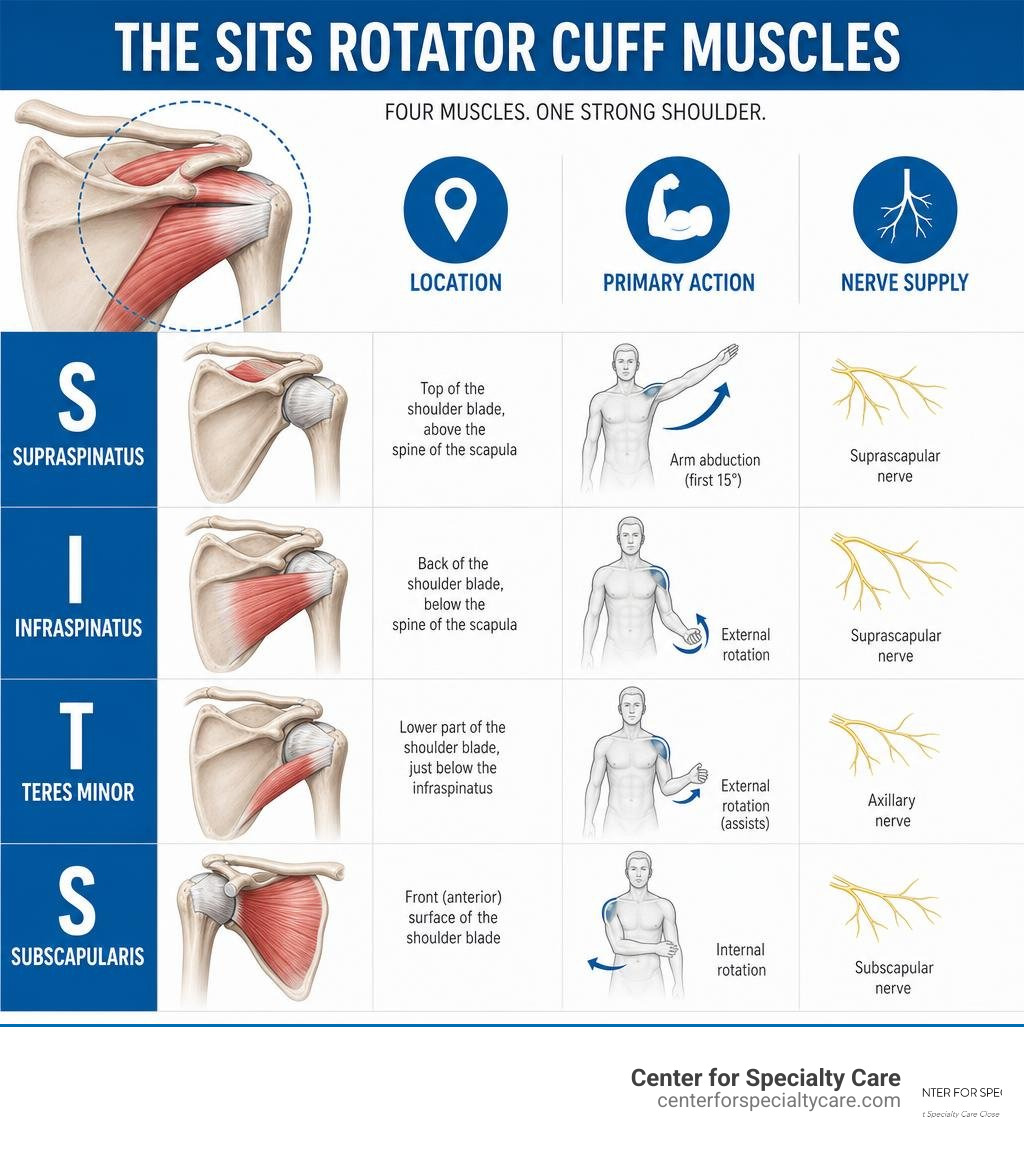
The muscles connected to rotator cuff function are a group of four muscles — often remembered by the acronym SITS — that wrap around the shoulder joint and hold the upper arm bone firmly in its socket.
Here’s a quick overview of all four:
| Muscle | Primary Action | Nerve Supply |
|---|---|---|
| Supraspinatus | Arm abduction (first 15°) | Suprascapular nerve |
| Infraspinatus | External rotation | Suprascapular nerve |
| Teres Minor | External rotation (assists) | Axillary nerve |
| Subscapularis | Internal rotation | Subscapular nerve |
Together, these four muscles form a cuff of tissue around the glenohumeral joint — the ball-and-socket joint that gives your shoulder its remarkable range of motion. Their tendons blend into the joint capsule, creating a strong, flexible sleeve that keeps the humeral head centered in the shallow glenoid socket during every arm movement you make.
Without this muscle group, even simple tasks — reaching overhead, throwing a ball, or sleeping on your side — can become painful or impossible.
Understanding how these muscles work, how they break down, and how injuries are treated is essential if you’re dealing with shoulder pain.
I’m Dr. Corey Welchlin, a board-certified orthopedic surgeon with over 30 years of experience treating shoulder conditions — including complex injuries involving the muscles connected to the rotator cuff — at the Center for Specialty Care in Fairmont, Minnesota. Throughout my career performing arthroscopic rotator cuff repairs and joint-replacement procedures, I’ve seen how a solid understanding of shoulder anatomy leads to better outcomes for patients.
The SITS Group: Muscles Connected to Rotator Cuff Function
The rotator cuff is not one single structure. It is a coordinated team of four muscles and their tendons that connect the shoulder blade, or scapula, to the upper arm bone, or humerus.
The SITS acronym stands for:
- Supraspinatus
- Infraspinatus
- Teres minor
- Subscapularis
These muscles form what medical sources often describe as a musculotendinous collar around the glenohumeral joint. That may sound fancy, but the idea is simple: the shoulder socket is shallow, so it needs soft-tissue support to keep the ball of the humerus centered while the arm moves.
Think of the shoulder like a golf ball on a tee. It has tremendous freedom, but not much built-in bony stability. The rotator cuff is the support crew that keeps the ball from wobbling off the tee. For a deeper look at this anatomy, we recommend our guide, A Deep Dive into Rotator Cuff Muscles and Tendons, along with this overview of Rotator Cuff Anatomy.
The Supraspinatus and Other Muscles Connected to Rotator Cuff Abduction
The supraspinatus is the muscle most people hear about first because its tendon is the one most commonly injured or torn.
It begins in the supraspinous fossa, a shallow groove on the top/back part of the shoulder blade. From there, it travels under the acromion, a bony roof over the shoulder, and attaches to the greater tuberosity of the humerus.
Its main job is abduction, which means lifting the arm away from the side of the body. The supraspinatus is especially important during the first 15 degrees of this motion. After that, the deltoid muscle does much of the heavy lifting, but the supraspinatus still helps guide and stabilize the movement.
Key facts:
- Main action: starts arm abduction
- Attachment: greater tuberosity of the humerus
- Nerve supply: suprascapular nerve
- Common issue: tendinopathy or tearing, especially with overhead use
The supraspinatus has to pass through a tight space under the acromion, so it is vulnerable to irritation, pinching, and gradual wear. You can learn more through this medical reference on the Anatomy of the Supraspinatus Muscle.
Infraspinatus and Teres Minor: External Rotation
The infraspinatus and teres minor work together to externally rotate the shoulder. External rotation is the motion you use when you turn your forearm outward, like when you reach back to throw a ball or put on a jacket.
The infraspinatus starts in the infraspinous fossa, below the spine of the scapula, and attaches to the greater tuberosity. It is one of the strongest external rotators of the shoulder.
The teres minor is smaller but still important. It sits just below the infraspinatus and also attaches to the greater tuberosity. Its nerve supply is the axillary nerve, the same nerve that also helps power the deltoid.
Together, these two muscles:
- Rotate the arm outward
- Help keep the humeral head centered in the socket
- Balance the stronger internal rotators on the front of the shoulder
- Protect the joint during throwing, lifting, pushing, and pulling
When these muscles are weak, the shoulder may feel unstable, tired, or painful during reaching and overhead activity.
The Subscapularis and Muscles Connected to Rotator Cuff Internal Rotation
The subscapularis is the largest and strongest rotator cuff muscle. It sits on the front surface of the scapula in the subscapular fossa, then travels forward to attach to the lesser tuberosity of the humerus.
Its main job is internal rotation, which means turning the arm inward. You use this motion when tucking in a shirt, reaching behind your back, fastening a bra, or pulling something toward your body.
The subscapularis also helps reinforce the front part of the shoulder joint capsule. Because of its size and position, it plays a major role in preventing the humeral head from sliding too far forward.
Important features:
- Main action: internal rotation
- Attachment: lesser tuberosity
- Nerve supply: upper and lower subscapular nerves
- Clinical concern: tears may cause weakness with behind-the-back motion
For more on how these four muscles work together, visit our page on Rotator Cuff Muscles.
Joint Stability: How the Rotator Cuff and Surrounding Structures Interact
The rotator cuff is not just a movement system. It is a dynamic stabilization system.
Every time you lift, reach, throw, or rotate your arm, the rotator cuff compresses the humeral head gently into the glenoid fossa, the shallow socket of the shoulder blade. This keeps the joint centered while bigger muscles, like the deltoid, latissimus dorsi, pectoralis major, and trapezius, generate power.
This balance is critical. If the deltoid pulls upward without the rotator cuff pulling the humeral head into position, the shoulder can pinch tissues under the acromion. That is one reason rotator cuff weakness can lead to impingement-type pain.
The rotator cuff also works with:
- The labrum
- The shoulder capsule
- The biceps tendon
- The coraco-acromial arch
- The deltoid
- The scapular stabilizing muscles
This is why shoulder pain is rarely about one isolated structure. It is usually about how the whole shoulder system is moving. We explain more in The Shoulder Joint’s Secret Support Squad.
The Role of the Biceps Tendon in Shoulder Stability
The long head of the biceps tendon is not part of the rotator cuff, but it lives close enough to be a frequent neighbor in shoulder problems.
This tendon begins near the top of the shoulder socket, attaching around the superior glenoid labrum, then travels through the shoulder joint and down the bicipital groove of the humerus. It is held in position by nearby ligament and tendon structures, including parts of the rotator cuff interval.
The biceps tendon can help with shoulder stability, especially at the front and top of the joint. But because it runs through a narrow groove and near the rotator cuff, it can become irritated when rotator cuff disease is present.
Common biceps-related problems that may occur with rotator cuff injuries include:
- Biceps tendinitis
- Biceps tendon instability
- SLAP-type labral irritation
- Pain in the front of the shoulder
- Clicking or catching sensations
This is one reason a complete shoulder evaluation looks beyond the cuff itself. Our guide, The Definitive Guide to Shoulder Joint Anatomy, explains these surrounding structures in more detail.
The Coraco-Acromial Arch and Subacromial Space
The coraco-acromial arch is formed by the acromion, the coracoid process, and the coraco-acromial ligament. It creates a protective roof over the humeral head and rotator cuff.
Under this arch is the subacromial space, which contains the supraspinatus tendon and the subacromial bursa. The bursa is a small fluid-filled cushion that helps the rotator cuff glide smoothly.
Problems can occur when this space becomes crowded. Causes may include:
- Rotator cuff swelling
- Subacromial bursitis
- Bone spurs
- Poor shoulder blade mechanics
- Thickening of soft tissues
- Repetitive overhead activity
When tissues are pinched under the arch, the result may be shoulder impingement syndrome. This often causes pain when lifting the arm overhead or reaching out to the side.
For a clinical anatomy reference, see Anatomy of the Rotator Cuff.
Rotator Cuff Pathology: Injuries, Degeneration, and Clinical Evaluation
Rotator cuff problems range from mild inflammation to complete tendon tears. The most common conditions include:
- Tendinopathy: tendon irritation or degeneration
- Tendinitis: inflammation of a tendon
- Tendinosis: chronic tendon wear and structural change
- Subacromial bursitis: inflammation of the bursa above the cuff
- Partial-thickness tear: damage to part of the tendon thickness
- Full-thickness tear: a tear through the entire tendon
- Massive tear: a large tear, often involving more than one tendon
The supraspinatus tendon is the most commonly torn structure. Tears may happen suddenly from trauma, such as a fall or heavy lift, or gradually from years of repetitive stress.
Risk factors include:
- Age-related tendon degeneration
- Repetitive overhead work or sports
- Previous shoulder injury
- Smoking
- Diabetes
- Obesity
- Family tendency toward tendon problems
- Poor posture or shoulder mechanics
Rotator cuff dysfunction can cause pain, weakness, reduced function, and a lower quality of life. The good news: about 80% to 85% of rotator cuff injuries improve without surgery when treated appropriately.
Learn more in The Rotator Cuff Revealed: Anatomy, Injuries, and What a Tear Really Means.
| Tear Type | What It Means | Common Symptoms | Typical Treatment Path |
|---|---|---|---|
| Partial-thickness tear | Tendon is damaged but not completely detached | Pain, weakness, pain with overhead use | Rest, therapy, medications, injections if appropriate |
| Full-thickness tear | Tear extends through the whole tendon | Weakness, night pain, limited motion | Therapy or surgery depending on size, age, activity, and function |
| Massive tear | Large tear or multiple tendons involved | Major weakness, loss of function, possible arthritis | Surgical repair or advanced procedures in selected cases |
Diagnosis usually includes a medical history, physical exam, strength testing, and sometimes imaging. X-rays can show arthritis or bone spurs. Ultrasound can identify many tendon tears. MRI is often used when we need detailed information about tear size, tendon retraction, muscle atrophy, or surgical planning.
Age-Related Degenerative Changes and Natural History
Rotator cuff tissue changes as we age. That does not mean everyone develops symptoms, but tendon quality often decreases over time.
Degenerative changes may include:
- Loss of tendon elasticity
- Thinning or fraying
- Reduced blood supply
- Partial tearing
- Full-thickness tearing
- Tendon retraction
- Muscle atrophy or fatty change
Many rotator cuff tears develop slowly. Some are even asymptomatic, meaning a person has a tear but no pain. Symptoms may appear later after a minor injury, an increase in activity, or a change in muscle balance.
This is why we do not treat MRI pictures alone. We treat the whole person: symptoms, function, strength, goals, age, occupation, activity level, and overall health.
Clinical Tests for Evaluating Rotator Cuff Integrity
A good shoulder exam helps identify which tendon may be involved. Common clinical tests include:
- Jobe test, or empty can test: evaluates the supraspinatus
- Drop arm test: screens for larger supraspinatus tears
- External rotation resistance test: evaluates infraspinatus strength
- Hornblower test: evaluates teres minor function
- Lift-off test: checks subscapularis strength
- Bear hug test: another useful subscapularis test
- Neer and Hawkins-Kennedy tests: screen for impingement-type pain
These tests are helpful, but they are not perfect. Pain, stiffness, arthritis, neck problems, and guarding can all affect the results. That is why we combine exam findings with history and imaging when needed.
For an easy patient-friendly overview, visit Simple Tests to Check for a Rotator Cuff Injury.
Treatment and Prevention: Restoring Shoulder Function
Treatment depends on the type of injury, the person’s goals, and how much function has been lost. In many cases, we start with non-surgical care because most rotator cuff problems improve without an operation.
The first goals are to:
- Reduce pain
- Calm inflammation
- Restore range of motion
- Improve rotator cuff strength
- Improve shoulder blade control
- Prevent worsening irritation
Prevention matters too. A strong, flexible shoulder is a happier shoulder. And yes, shoulders can be dramatic. They like attention, but preferably the physical-therapy kind.
Helpful prevention habits include:
- Warm up before sports or heavy work
- Avoid sudden increases in overhead activity
- Strengthen the rotator cuff and shoulder blade muscles
- Maintain good posture
- Use proper lifting technique
- Do not “play through” sharp shoulder pain
- Address mild symptoms before they become major problems
For more on treatment options, see Rotator Cuff Tear and Treatment.
Non-Surgical Management and Rehabilitation
Non-surgical treatment may include:
- Activity modification
- Ice or heat
- Anti-inflammatory medications when appropriate
- Acetaminophen for pain relief when appropriate
- Physical therapy
- Home exercises
- Corticosteroid injections in selected cases
Corticosteroid injections may reduce inflammation and pain, but they are used thoughtfully because repeated injections can weaken tendon tissue over time.
Common exercises may include:
- Pendulum exercise: gentle motion using gravity
- Sleeper stretch: improves posterior shoulder flexibility
- Cross-body stretch: helps posterior capsule tightness
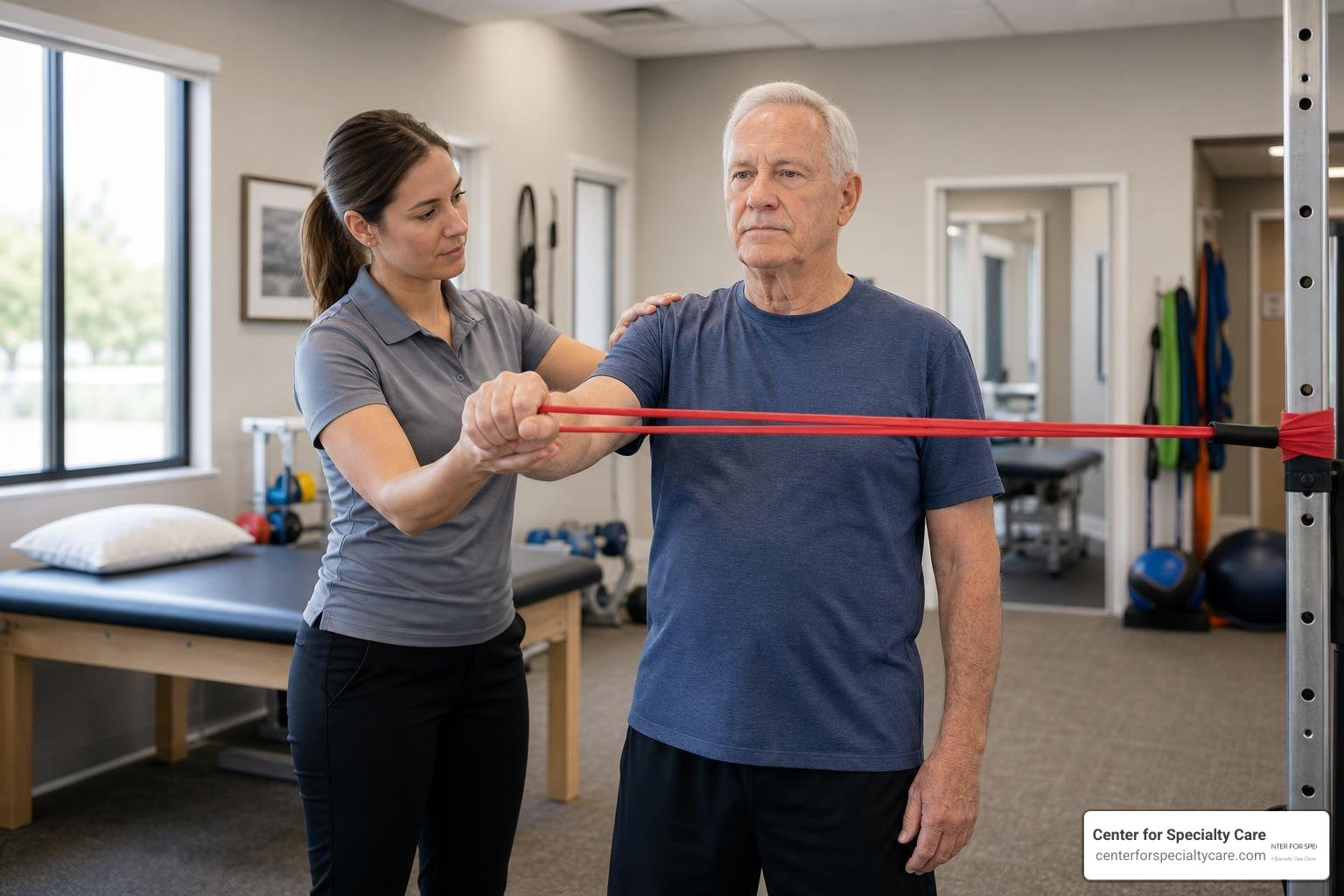
- External rotation with resistance band: strengthens infraspinatus and teres minor
- Internal rotation with resistance band: strengthens subscapularis
- Scapular retraction: improves shoulder blade posture
- Wall slides: improves controlled overhead motion
Best practice: exercises should be comfortable, controlled, and progressive. Sharp pain is your shoulder’s way of saying, “Please reconsider your life choices.” Stop and check with a healthcare professional if pain increases.
Surgical Options for Severe Tears
Surgery may be considered when:
- A full-thickness tear causes significant weakness
- Symptoms continue despite appropriate conservative care
- A traumatic tear occurs in an active patient
- The tendon is retracting
- Muscle atrophy is developing
- Function is significantly limited
Common surgical options include:
- Arthroscopic rotator cuff repair: small incisions and a camera-guided repair
- Debridement: smoothing damaged tissue in selected cases
- Subacromial decompression: creating more space when appropriate
- Biceps tenodesis or tenotomy: treatment for painful biceps tendon disease
- Reverse shoulder replacement: for severe cuff tear arthropathy or irreparable tears in selected patients
Recovery after rotator cuff repair often takes months. Many patients use a sling for several weeks, then progress from passive motion to active motion and strengthening. Full recovery varies, but strength and function can continue improving for 6 to 12 months or longer.
For additional details, visit Rotator Cuff Tear.
Frequently Asked Questions about Rotator Cuff Anatomy
What are the symptoms of a torn rotator cuff?
Common symptoms include:
- Dull ache deep in the shoulder
- Pain that worsens at night
- Pain when lying on the affected side
- Weakness lifting or rotating the arm
- Trouble reaching overhead
- Difficulty reaching behind the back
- Clicking or catching
- Limited range of motion
A sudden traumatic tear may cause immediate, intense pain and noticeable arm weakness. A degenerative tear may start as mild soreness and slowly progress.
If symptoms persist, do not guess your way through it. A proper diagnosis can prevent a small problem from becoming a bigger one. Learn more at Signs You Might Have a Torn Rotator Cuff.
Can a rotator cuff tear heal on its own without surgery?
It depends on the tear.
A mild strain or tendinopathy can often improve with rest, activity modification, and physical therapy. Some partial-thickness tears become less painful even if the tendon does not fully “regrow” to normal. The body may form scar tissue, and strengthening the surrounding muscles can restore function.
Full-thickness tears are less likely to anatomically heal on their own, especially if the tendon has pulled away from the bone. However, not every full-thickness tear requires surgery. Many people improve with conservative care, especially when pain decreases and function returns.
The decision depends on:
- Tear size
- Age of the tear
- Tendon retraction
- Muscle quality
- Pain level
- Strength
- Activity demands
- Overall health
For a general anatomy overview, see Rotator Cuff Anatomy and Function.
What is the most commonly injured rotator cuff muscle?
The supraspinatus tendon is the most commonly injured part of the rotator cuff.
Why? It passes through the narrow subacromial space, has high mechanical demands during lifting, and is exposed to repetitive strain during overhead activity. Over time, irritation, impingement, and reduced tendon quality can lead to tendinopathy or tearing.
People at higher risk include:
- Overhead athletes
- Manual laborers
- Painters and carpenters
- Weightlifters
- Adults over 40
- People with prior shoulder injuries
- Individuals with diabetes or smoking history
For a broader medical reference on shoulder muscles, visit Shoulder Muscles Anatomy.
Conclusion
The muscles connected to rotator cuff function may be small compared with the big power muscles of the shoulder, but they do some of the most important work. The supraspinatus, infraspinatus, teres minor, and subscapularis keep the shoulder centered, stable, and ready for everything from reaching a cabinet to throwing a baseball.
When one part of this system breaks down, pain and weakness can follow. The good news is that many rotator cuff injuries improve with non-surgical treatment, especially when diagnosed early and treated with a personalized plan.
At Center for Specialty Care, we provide comprehensive orthopedic and pain management care for patients in Fairmont, Minnesota, and our surrounding Minnesota and Iowa communities, including Estherville, Buffalo Center, and St. James. We offer both surgical and non-surgical shoulder care, quick appointment availability, and a personalized approach focused on helping you return to the activities you enjoy.
If shoulder pain is limiting your life, we are here to help you understand the problem and choose the right next step.