

Everything You Need to Know About Foot Tendons
June 17, 2026
Why You Have Rhomboid Muscle Pain After a Car Accident and How to Fix It
June 22, 2026
The Ultimate Rhomboid Pain Sleeping Position Guide
Why Sleeping with Rhomboid Pain Feels Impossible — and What Actually Helps
Learning how to sleep with rhomboid pain doesn’t have to mean another night of tossing and turning. Here’s a quick answer to get you started:
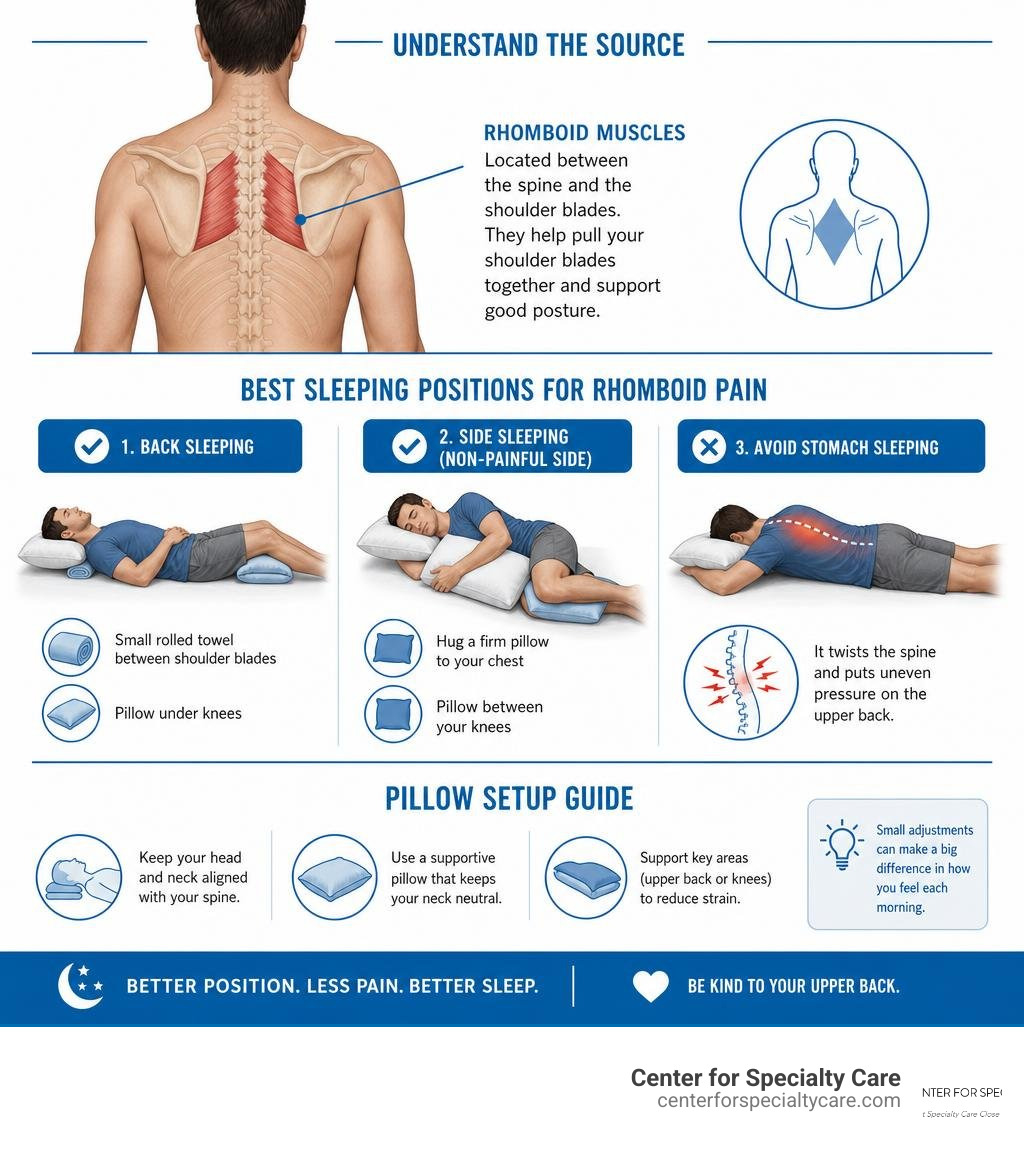
Best sleeping positions for rhomboid pain:
- Back sleeping — lie flat with a small rolled towel between your shoulder blades and a pillow under your knees
- Side sleeping (non-painful side) — hug a firm pillow to your chest and place another pillow between your knees
- Avoid stomach sleeping — it twists the spine and puts uneven pressure on the upper back
That deep, burning ache between your shoulder blades has a way of intensifying the moment your head hits the pillow. The muscles you’ve been fighting all day — your rhomboids, the diamond-shaped muscles that run from your spine to the inner edges of your shoulder blades — suddenly have nowhere to go. Every position feels like it presses directly on the problem.
You’re not imagining it. Up to 30–50% of people with chronic back pain report their symptoms worsen at night, often because lying still removes the gentle movement that keeps muscles loose during the day.
The good news? A few targeted changes to how you position your body at night can make a meaningful difference — often within just a few nights.
I’m Dr. Corey Welchlin, a board-certified orthopedic and sports medicine surgeon with over 30 years of experience treating musculoskeletal pain, including the upper back conditions that make knowing how to sleep with rhomboid pain so critical to recovery. In the guide below, I’ll walk you through exactly what’s going on in your upper back at night and what to do about it.
How to sleep with rhomboid pain terms you need:
Understanding Rhomboid Pain and Why It Worsens at Night
To solve a problem, we first need to understand the mechanics behind it. The upper back is essentially the “engine room” of your posture. When you lie down to sleep, this area should ideally relax and recover. However, if you are struggling with a knot in rhomboid tissue, sleep can quickly become a battleground.
The rhomboids (major and minor) are two thin, diamond-shaped muscles located in the upper back. They connect the inner edge of your shoulder blades (scapulae) to your spine. Their primary job is to retract the shoulder blades — pulling them backward and stabilizing the entire shoulder girdle. They also assist with thoracic expansion when you take a deep breath.
When these muscles are strained, overworked, or spasming, they develop highly sensitive trigger points. If you are experiencing a pain under scapula, it is highly likely that your rhomboids are either structurally strained or reacting to a deeper postural imbalance.
What Causes Rhomboid Muscle Pain?
For most of us, rhomboid discomfort does not stem from a sudden, dramatic athletic injury. Instead, it is a slow-burning consequence of daily life. The most common culprits behind Rhomboid Muscle Pain include:
- Poor Posture (The “Tech Neck” Effect): The average human head weighs 10 to 12 pounds. When you slouch forward to look at a computer or phone, that weight acts like a bowling ball pulling on your spine. Your rhomboids must work overtime in a stretched, weakened state to keep your shoulders from collapsing completely forward.
- Muscle Knots and Trigger Points: Prolonged postural strain leads to myofascial pain syndrome, where hyperirritable spots (muscle knots) develop. These feel like tiny, hard marbles under the skin that ache constantly.
- Repetitive Strain: Repetitive throwing, pulling, or overhead reaching can overwork these stabilizing muscles. This is common in rowers, tennis players, and manual laborers.
- Weakness and Imbalance: Many people focus on stretching their tight upper back, but the real issue is often that the rhomboids are too weak and overstretched, while the chest muscles (pectorals) are tight and pulling the shoulders forward.
To learn more about the underlying causes, you can read our comprehensive guide on how to relieve a muscle knot in shoulder blade.
Why Upper Back Pain Flares Up When Lying Down
If your back only aches mildly during the day, you might wonder why it starts throbbing the minute you try to rest. There are three primary reasons for this nighttime flare-up:
- Direct Pressure on Inflamed Tissue: When you lie flat on your back, your body weight compresses the already irritated muscles against the mattress. This reduces blood flow to the area, limiting the oxygen and nutrients needed for recovery.
- Immobility and Stiffness: During the day, you are constantly moving, which keeps blood circulating. At night, hours of relative immobility allow the muscles to stiffen and trigger points to tighten up.
- Spinal Alignment Issues: If your mattress or pillow does not support the natural curves of your neck and upper back, your spine is forced out of alignment. Your rhomboids must then go back to work — contracting to protect your spine while you are trying to sleep.
According to research shared by Rhomboid muscle pain: Symptoms, causes, treatment, and more, sleeping on your side without proper support can unevenly stretch the upper back muscles, exacerbating these symptoms.
How to Sleep with Rhomboid Pain: Best and Worst Positions
Up to 80% of adults experience back pain at some point in their lives, with poor sleep posture being a massive contributing factor. By choosing a sleep position that promotes neutral spinal alignment, you can reduce muscular tension and allow your upper back to heal.
Back Sleeping with Thoracic and Knee Support
If you can manage it, back sleeping is widely considered the gold standard for upper back pain relief. It distributes your body weight evenly across the largest surface area, minimizing pressure points.
To optimize this position:
- The Head Pillow: Use a medium-firm pillow that supports the natural curve of your neck without pushing your head too far forward.
- The Thoracic Towel Roll: Place a very thin, rolled-up towel vertically down your spine between your shoulder blades. This provides gentle traction, prevents your shoulders from rounding forward, and unloads the rhomboids.
- The Knee Pillow: Place a supportive pillow under your knees. This flattens your lower back against the mattress and maintains overall spinal alignment.
Implementing these adjustments can help reduce local stress, as detailed in The Complete Guide to Relieving Rhomboid Pain.
Side Sleeping with a Pillow Hug
If you are a dedicated side sleeper, you do not have to force yourself to sleep on your back. However, sleeping on your side without modifications can cause your top shoulder to collapse forward, putting your rhomboids on a painful, eight-hour stretch.
To make side sleeping highly therapeutic:
- Sleep on the Unaffected Side: Keep your painful shoulder facing upward to avoid direct compression.
- The Pillow Hug: Hug a firm pillow tightly to your chest. This keeps your top shoulder joint stable and prevents it from dropping forward, which decompresses the rhomboids.
- The Knee Pillow: Place a supportive pillow between your knees. Side sleeping with proper pillow support can reduce spinal pressure by up to 30% compared to stomach sleeping, and using a pillow between the knees can decrease lower back pain by up to 50% in chronic pain sufferers.
For more visual guides on this setup, explore the Best Rhomboid Pain Sleeping Positions for Relief – Easy Rest.
Sleeping Positions to Avoid: Stomach Sleeping and Arm Elevation
If you are struggling with upper back pain, stomach sleeping is the ultimate “no-no.”
When you sleep on your stomach, you are forced to turn your head to one side to breathe. This twists your cervical spine and puts immense, asymmetrical strain on the muscles connecting your neck to your shoulder blades.
Furthermore, stomach sleeping flattens the natural curves of your spine and often forces you to sleep with your arms elevated under your head or pillow. Raising your arms above your head shortens the muscles of the upper back and neck, pinch-points nerves, and restricts healthy blood flow. If you want to know how to sleep with rhomboid pain successfully, you must train yourself to avoid stomach sleeping entirely.
Optimizing Your Sleep Setup: Pillows, Mattresses, and Pre-Bed Routines
Your sleep environment plays an active role in how your muscles recover overnight. If your mattress is sagging or your pillows are worn out, even the best sleeping positions won’t provide lasting relief.
Choosing the Right Pillow and Mattress Support
Your head pillow should keep your ear directly in line with your shoulder when viewed from the side. If your pillow is too thick, it pushes your head forward; if it is too thin, your neck sags toward the mattress. Both scenarios create compensatory tension in the upper back and can lead to a painful knot in neck and shoulder blade.
When it comes to your mattress, you need a balance of spinal alignment and pressure relief. A mattress that is too soft will cause your hips and shoulders to sink unevenly, while a mattress that is too firm won’t cushion your shoulders, leading to direct bruising of inflamed muscle tissue.
| Mattress Firmness | Best For | Impact on Rhomboid Pain |
|---|---|---|
| Soft | Side sleepers who need deep shoulder cushioning | May cause spinal sagging, leading to muscle strain |
| Medium-Firm | Back and side sleepers (The “Happy Medium”) | Keeps spine neutral while offering enough cushion for shoulders |
| Firm | Heavy back sleepers | Excellent support, but may press too hard on active trigger points |
For more tips on choosing supportive sleep gear, see the recommendations in How to Sleep With Rhomboid Pain – Plank Mattress.
Pre-Bed Stretches and Heat Therapy for Quick Relief
Preparing your muscles for sleep is just as important as the position you sleep in. Applying heat therapy before bed has been shown to improve sleep quality by 20–30% in individuals with musculoskeletal pain. Heat dilates blood vessels, increases oxygen flow, and relaxes tight fibers.
Try this simple, 10-minute pre-bed routine:
- Heat Therapy (15 Minutes): Apply a warm compress or heating pad to your upper back.
- Doorway Chest Stretch (30 Seconds): Stand in a doorway, place your forearms on the doorframe, and gently step forward until you feel a comfortable stretch across your chest. Hold for 30 seconds to open your chest and relieve the forward pull on your upper back.
- Cross-Body Shoulder Stretch (20 Seconds per side): Bring one arm across your chest and gently press it closer with your opposite hand.
- Tennis Ball Self-Massage (2 Minutes): Place a tennis ball between your upper back and a wall. Gently lean your weight into the ball and roll it around to release active trigger points. If you find a tender spot, hold still for 60 to 90 seconds until the knot begins to release.
For a complete exercise plan, check out our guide on Rhomboid Pain Relief Exercises That Actually Work.
Daytime Posture Habits to Prevent Nighttime Pain
You cannot spend 16 hours slouching at a desk and expect your upper back to feel perfect the moment you lie down. Posture carries over from the day straight into the night.
To protect your back during the day:
- Adjust Your Screen: Keep your computer monitor at eye level so you do not tilt your head forward.
- Take Movement Breaks: Set a timer to stand, stretch, or walk for 2 minutes every 30 to 45 minutes.
- Strengthen Your Back: Incorporate exercises like band pull-aparts, wall slides, and seated rows into your weekly routine to build the endurance your rhomboids need to support your spine.
To learn more about long-term recovery, read The Ultimate Rhomboid Muscle Strain Recovery Plan.
Frequently Asked Questions about Upper Back Pain
What is the best position how to sleep with rhomboid pain?
The best overall position is sleeping on your back with a supportive pillow under your knees and a very small rolled towel placed vertically between your shoulder blades. If you must sleep on your side, sleep on the non-painful side, hug a firm pillow to your chest to keep your shoulders stable, and place a pillow between your knees to keep your hips and spine aligned.
Can a bad pillow affect how to sleep with rhomboid pain?
Absolutely. A pillow that is too high or too flat forces your neck out of its natural alignment. Because the nerves that control your rhomboids originate in your neck (specifically the C5-C7 nerve roots), cervical misalignment can cause referred pain and protective muscle spasms directly between your shoulder blades.
When should I seek professional medical help for persistent pain?
While a mild muscle strain should improve within 2 to 3 weeks of home care, you should seek professional evaluation if:
- Your pain persists beyond 3 to 4 weeks without improvement.
- The pain is severe enough to wake you up repeatedly throughout the night.
- You experience numbness, tingling, or weakness radiating down your arm or into your fingers, which may indicate a pinched nerve in shoulder blade or a cervical spine issue.
- You experience shortness of breath or pain when taking deep breaths.
To understand other potential causes of localized upper back knots, you can read our article on the common muscle knot shoulder blade triggers.
Conclusion
Waking up exhausted because of chronic upper back pain is incredibly frustrating, but you do not have to live with it. By adjusting your sleeping position, optimizing your pillow setup, and incorporating simple pre-bed stretches, you can finally give your rhomboids the rest they need to heal.
If at-home adjustments aren’t providing the relief you deserve, our team at the Center for Specialty Care is here to help. At our orthopedic and pain management clinics in Fairmont, MN, as well as our locations in Estherville, IA, Buffalo Center, IA, and St. James, MN, we specialize in providing personalized, comprehensive care. Whether your upper back pain is a simple muscle strain or stems from a cervical spine issue, we offer both advanced non-surgical and surgical treatments tailored to your unique needs.
We pride ourselves on our 100% patient satisfaction, warm and personalized care, and quick appointment availability so you don’t have to wait to start feeling better. Schedule a consultation for back pain relief with us today, and let’s get you back to sleeping soundly.