
Best Ways to Treat a Painful Achilles Tendon
June 4, 2026
How Foot Pads for Flat Feet Can Save Your Soles
June 9, 2026
Say Goodbye to the Ache with These Simple Scapula Exercises
That Nagging Ache Under Your Shoulder Blade Deserves Real Answers
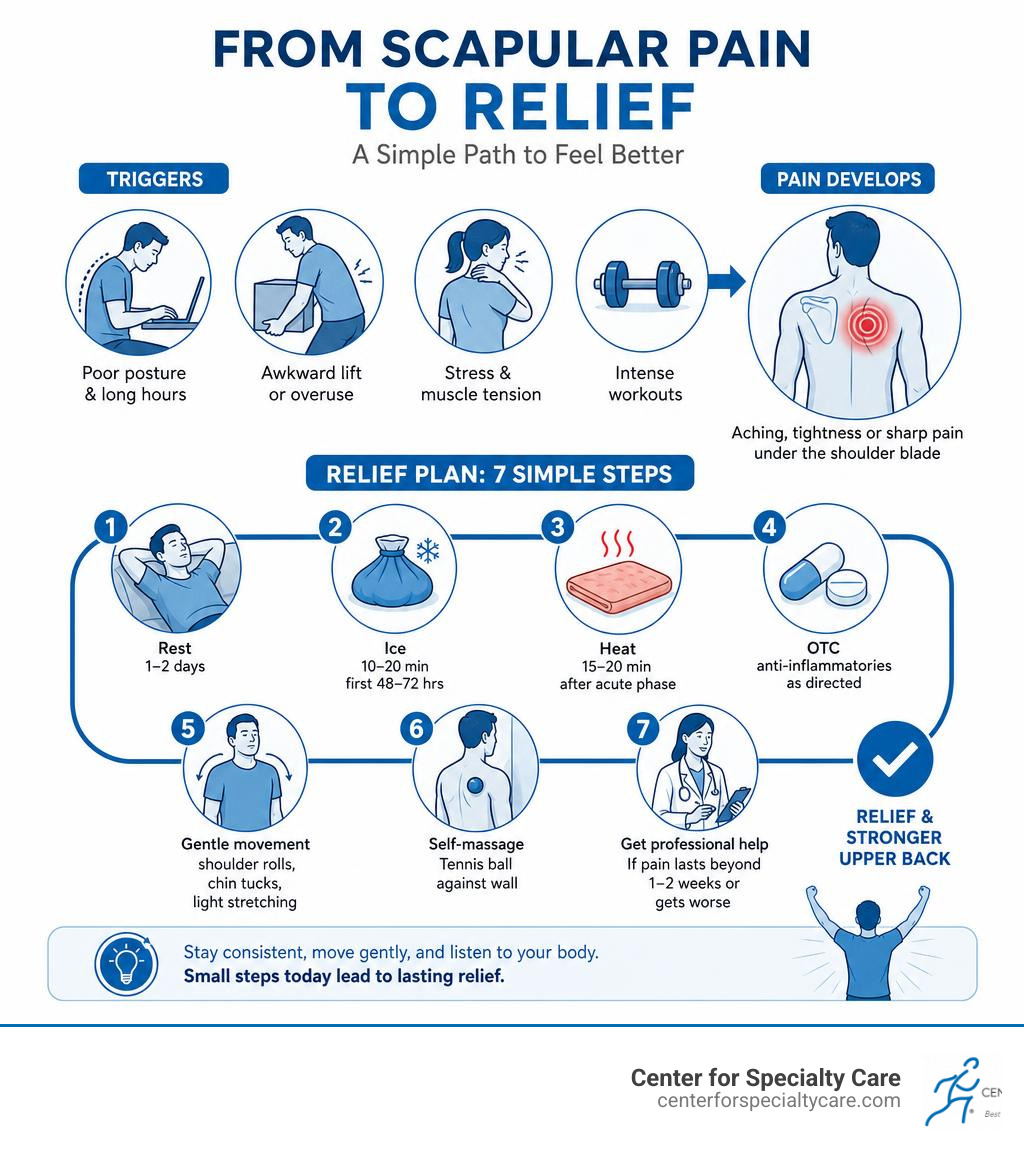
If you’re searching for how to relieve pain under scapula, here are the most effective steps to start feeling better:
- Rest from activities that make it worse (1–2 days for acute pain)
- Apply ice wrapped in a cloth for 10–20 minutes during the first 48–72 hours
- Switch to heat (warm shower or heating pad, 15–20 minutes) once the acute phase passes
- Take OTC anti-inflammatories like ibuprofen or naproxen as directed on the label
- Gentle movement — shoulder rolls, chin tucks, and light stretching to ease stiffness
- Self-massage with a tennis ball against a wall to release muscle knots under the blade
- See a doctor or physical therapist if pain lasts beyond 1–2 weeks or gets worse
Pain under the shoulder blade — also called interscapular pain — is one of the most common complaints in upper back care. It can feel like a dull ache, a sharp stab, or a burning sensation that spreads across your upper back or into your neck. For most people, it starts with something simple: hours hunched over a screen, an awkward lift, a tough workout, or even a stressful week at work.
The frustrating part? The shoulder blade area is hard to reach, easy to ignore, and simple to misread. People often chalk it up to a “sore muscle” and push through — until it becomes a persistent problem that disrupts sleep, work, and daily life.
The good news is that most cases respond well to the right combination of rest, targeted movement, and posture correction. This guide walks you through everything you need to know — from safe home relief to when it’s time to get professional help.
I’m Dr. Corey Welchlin, a board-certified orthopedic surgeon with over 30 years of experience treating patients with shoulder and upper back pain — including the full range of conditions that cause pain under the scapula. In that time, I’ve seen how the right early approach can prevent weeks of unnecessary suffering, and I’ll share what actually works based on that clinical experience throughout this guide.
Simple how to relieve pain under scapula word guide:
Why Pain Under the Shoulder Blade Happens
Pain under the scapula can come from muscles, joints, nerves, posture habits, or, less commonly, referred pain from internal organs. Shoulder pain affects about 18-26% of adults at any given time, and scapular or interscapular pain is one of the common ways it shows up.
The scapula is not just a flat bone sitting on your back. It glides over your rib cage and depends on several muscles to move smoothly, including the rhomboids, trapezius, levator scapulae, serratus anterior, and rotator cuff muscles. When one part of that system gets overworked or under-supported, pain can sneak in like an unwanted houseguest.
Common causes include:
- Muscle strain from lifting, twisting, or sudden movement
- Rhomboid or trapezius tension
- Trigger points, often called muscle knots
- Tech neck and rounded shoulders
- Scapular dyskinesis, meaning abnormal shoulder blade movement
- Neck issues such as cervical radiculopathy or a pinched nerve
- Thoracic spine or rib joint irritation
- Arthritis
- Trauma, such as a fall or car accident
- Stress-related shoulder hiking and muscle guarding
- Referred pain from the gallbladder, heart, or lungs
For a deeper explanation of causes, see our pain under scapula guide and our resource on rhomboid muscle pain.

Common Musculoskeletal Causes of Pain Under the Scapula
Most pain under the shoulder blade is musculoskeletal. That means it comes from muscles, tendons, joints, nerves, or movement mechanics.
The usual suspects include:
- Desk posture: Sitting with the head forward and shoulders rounded overloads the upper back.
- Phone posture: Looking down for long periods increases neck and scapular muscle strain.
- Lifting strain: Moving furniture, lifting weights, shoveling, or carrying heavy bags can irritate the rhomboids and trapezius.
- New workouts: Push-ups, rows, overhead presses, pickleball, swimming, and yard work can all trigger pain if your muscles are not ready.
- Sleeping position: A pillow that is too high, stomach sleeping, or sleeping with the arm overhead may irritate the shoulder blade area.
- Muscle knots: Trigger points can create a deep, nagging ache that feels hard to pinpoint.
- Scapular winging or dyskinesis: The shoulder blade may pop, grind, stick out, or move unevenly.
Muscle-related scapular pain is often tender to touch, worse with certain movements, and better with rest, heat, massage, or posture correction. Learn more about stubborn knots in our guides to muscle knot shoulder blade and scapula pain.
How to Tell Muscle Pain From Referred Pain
The key question is whether the pain behaves like a mechanical problem or something deeper.
| Clue | More likely musculoskeletal | More concerning for referred pain |
|---|---|---|
| Trigger | Lifting, posture, workout, sleep position | Eating fatty meals, exertion, illness, sudden onset |
| Movement | Changes with neck, shoulder, or upper back motion | Does not change with movement or position |
| Touch | Tender spots or knots are present | No local tenderness |
| Sensation | Achy, tight, sharp with movement | Deep pressure, heaviness, squeezing, unexplained burning |
| Other symptoms | Stiffness, limited motion | Chest pressure, shortness of breath, nausea, sweating, fever, cough |
| Side | Either side | Right scapula can relate to gallbladder; left scapula can relate to heart |
| Nerve signs | Possible tingling if neck-related | Weakness, numbness, coordination changes need evaluation |
Pain under the left shoulder blade is not automatically heart-related, but it deserves caution. If left scapular pain comes with chest pressure, jaw pain, shortness of breath, nausea, dizziness, or cold sweats, seek emergency care. For more, read our guide to pain below left scapula.
Red Flags You Should Never Ignore
Do not try to stretch, roll, or “walk off” scapular pain if you have red flags.
Seek immediate medical attention for:
- Chest pain, chest pressure, or tightness
- Pain spreading to the jaw, left arm, back, or shoulder blade
- Shortness of breath or difficulty breathing
- Dizziness, fainting, nausea, or cold sweats
- Sudden, severe pain
- Pain after a fall, crash, or direct blow
- Visible deformity, major swelling, or bruising
- Fever, persistent cough, or coughing blood
- Unexplained weight loss
- Constant night pain that does not change with position
- New numbness, weakness, clumsiness, or loss of coordination
When in doubt, get checked. Shoulder blade pain is usually manageable, but the rare serious causes are not worth gambling with.
How to Relieve Pain Under Scapula at Home Safely
The safest home plan depends on whether the pain is new and irritated or chronic and stiff. Acute pain needs calming. Chronic pain needs mobility, strength, and habit change.
A helpful overview of basic self-care can be found in this external guide to relieving pain under the shoulder blade.
How to Relieve Pain Under Scapula in the First 48–72 Hours
If the pain started suddenly after lifting, exercise, or a strain, treat it like an acute soft-tissue irritation.
Try this:
Use relative rest for 1-2 days.
- Avoid the activity that caused it.
- Do not stay completely inactive. Gentle walking and easy movement help prevent stiffness.
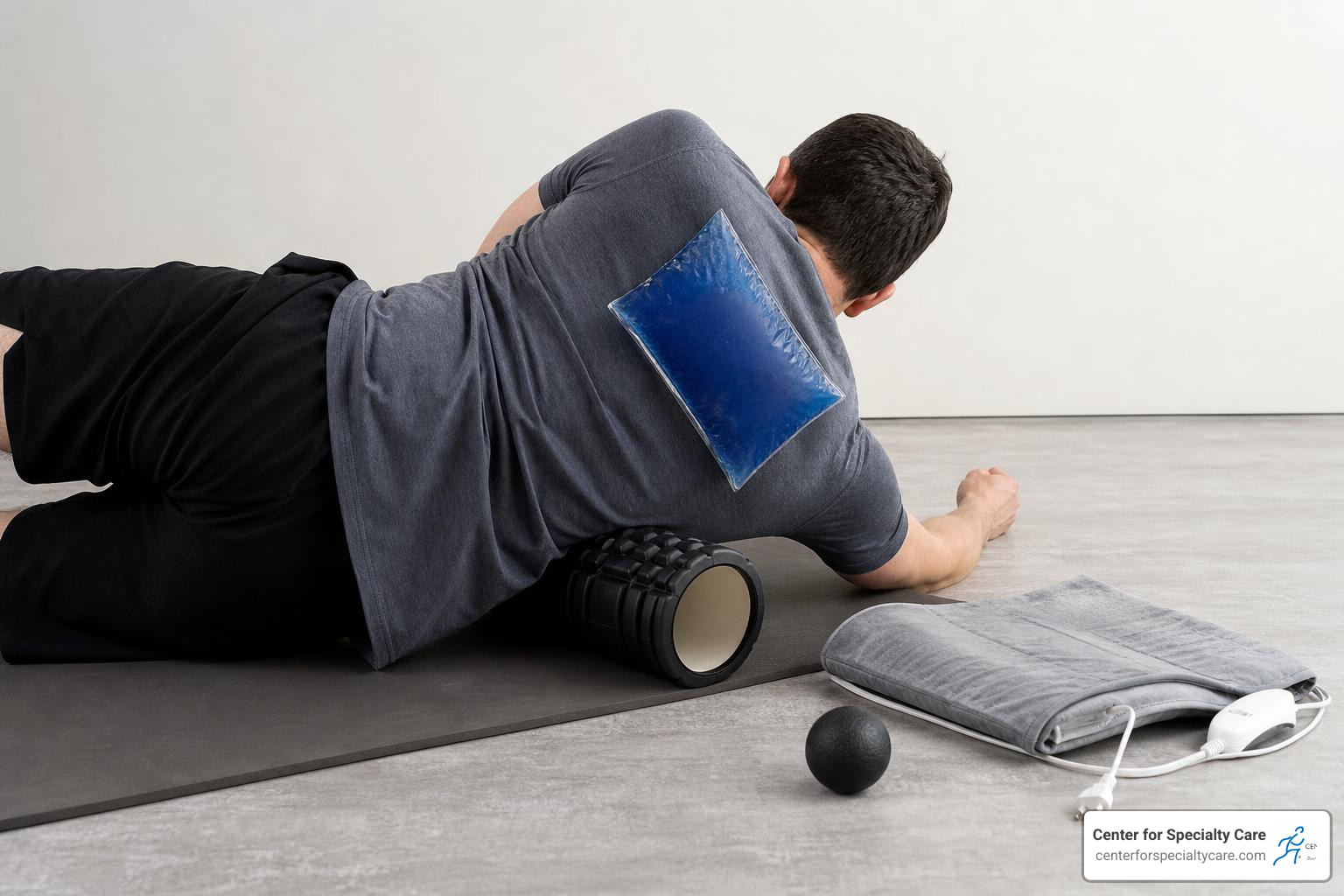
Apply ice.
- Wrap an ice pack in a towel.
- Apply for 10-20 minutes.
- Repeat several times per day with breaks between sessions.
- Never place ice directly on skin.
Move in a pain-free range.
- Shoulder rolls, easy neck motion, and gentle arm swings are enough at first.
- Stop if you feel sharp, spreading, or worsening pain.
Consider OTC medication if appropriate.
- Ibuprofen or naproxen may help inflammation, but follow the label.
- Avoid NSAIDs if you have been told not to take them due to stomach, kidney, heart, blood thinner, or other medical concerns.
- Acetaminophen may help pain but must be used carefully, especially with liver disease or alcohol use.
The goal is not to become a couch statue. The goal is to calm the irritated tissue while keeping the area from locking up.
How to Relieve Pain Under Scapula When It Feels Chronic or Stiff
If the pain has been hanging around for weeks, feels tight, or improves with warmth, heat often works better than ice.
Try:
- Moist heat or a warm shower for 15-20 minutes
- A heating pad with a cloth barrier
- Gentle thoracic extension over a towel or foam roller
- Posture resets every hour
- Slow breathing to reduce stress-related muscle guarding
- Gradual strengthening for the scapular stabilizers
Chronic scapular pain often comes from repeated overload, not one dramatic injury. That means the solution is usually repeated small fixes: move better, sit better, breathe better, and strengthen consistently. Not glamorous, but very effective. Your shoulder blade does not need drama. It needs routine.
Safe Self-Massage and Foam-Roller Techniques
Self-massage can help trigger points under and around the shoulder blade, but it should feel like “good pressure,” not punishment.
For a wall massage:
- Place a tennis ball or lacrosse ball between your upper back and a wall.
- Stay off the spine itself.
- Roll slowly along the muscles between the shoulder blade and spine.
- When you find a tender spot, hold light to moderate pressure for about 20-30 seconds.
- Breathe slowly.
- Stop if pain shoots down the arm, causes numbness, or feels sharp.
For foam rolling:
- Lie with the roller across your upper back, not your low back.
- Support your head with your hands.
- Roll slowly from the upper back to mid-back.
- Avoid direct pressure on the neck, spine bones, or ribs.
- Use 1-2 minutes, then reassess.
Helpful resources:
Best Scapula Exercises and Stretches for Relief and Prevention
Exercises work best when they combine mobility, stretching, and strengthening. Stretching may calm symptoms, but strengthening keeps them from returning.
Use these rules:
- Move slowly.
- Stay in a pain-free range.
- Breathe normally.
- Start with 1 set, then build.
- Mild stretching is fine. Sharp pain is not.
- If symptoms travel down the arm, stop and get evaluated.
For a visual exercise option, you can also watch this external scapula and rhomboid exercise video.
How to Relieve Pain Under Scapula With Gentle Mobility Drills
Start here if you feel stiff, guarded, or sore.
Shoulder rolls:
- Sit or stand tall.
- Roll shoulders up, back, down, and forward.
- Do 8-12 slow reps, then reverse.
Cat-cow:
- Start on hands and knees.
- Arch your back gently, then round it.
- Do 8-12 reps.
Thread the needle:
- Start on hands and knees.
- Slide one arm under your body.
- Let your upper back rotate gently.
- Hold 15-30 seconds per side.
Thoracic extension:
- Place a rolled towel or foam roller across your upper back.
- Support your head.
- Gently lean back over it.
- Repeat 8-10 times.
Open books:
- Lie on your side with knees bent.
- Reach the top arm across your body and rotate your chest open.
- Do 8-10 reps per side.
Neck retractions, or chin tucks:
- Look straight ahead.
- Glide your chin backward like you are making a “double chin.”
- Hold 2-3 seconds.
- Repeat 8-12 times.
Stop if any drill causes sharp pain, dizziness, arm weakness, or worsening symptoms.
Stretches That Target Tight Muscles Around the Shoulder Blade
Most stretches should be held 15-30 seconds and repeated 2-4 times. No bouncing. Bouncing belongs on trampolines, not angry shoulder blades.
Rhomboid stretch:
- Reach both arms forward.
- Clasp your hands.
- Round the upper back gently.
- Feel a stretch between the shoulder blades.
Cross-body shoulder stretch:
- Bring one arm across your chest.
- Use the opposite hand to apply gentle pressure.
- Keep the shoulder relaxed.
Doorway chest stretch:
- Place forearms on a doorframe.
- Step forward until you feel a stretch across the chest.
- Keep ribs down and avoid arching the low back.
Upper trapezius stretch:
- Sit tall.
- Gently tilt one ear toward the shoulder.
- Keep the opposite shoulder relaxed.
Levator scapulae stretch:
- Turn your nose toward your armpit.
- Gently nod downward.
- You should feel the stretch along the back/side of the neck.
Child’s pose or puppy pose:
- Reach arms forward while sitting hips back or keeping hips high.
- Let the upper back lengthen.
For more targeted ideas, see our guide to stretch for knot in shoulder blade.
Strengthening Exercises That Keep Pain From Coming Back
Once pain calms down, strength becomes the main event. The goal is better scapular control and endurance.
Shoulder-blade squeezes:
- Sit or stand tall.
- Gently squeeze shoulder blades together.
- Hold 3-6 seconds.
- Do 8-12 reps.
Band rows:
- Secure a resistance band at chest height.
- Pull elbows back.
- Squeeze shoulder blades gently.
- Do 2-3 sets of 8-12 reps.
Wall angels:
- Stand with back near a wall.
- Keep ribs down.
- Slide arms up and down like a snow angel.
- Do 8-12 slow reps.
Prone Y-T-I raises:
- Lie face down.
- Lift arms into a Y, then T, then I position.
- Keep movements small and controlled.
- Hold 2-3 seconds.
Scapular push-ups:
- Start at a wall, countertop, or floor.
- Keep elbows straight.
- Let chest move slightly toward and away from the shoulder blades.
- Do 8-12 reps.
Overhead pulldowns or chest-level pulls:
- Use a light band.
- Keep shoulders relaxed.
- Pull with control, not momentum.
Our more detailed strengthening plan is here: The complete guide to relieving rhomboid pain.
Fix the Posture and Movement Habits That Keep Irritating the Scapula
Poor posture is linked to a large share of upper back and scapular pain cases. The common pattern is forward head, rounded shoulders, tight chest muscles, and tired mid-back muscles. In plain English: your upper back is doing overtime while your chest and neck are stealing the chair.
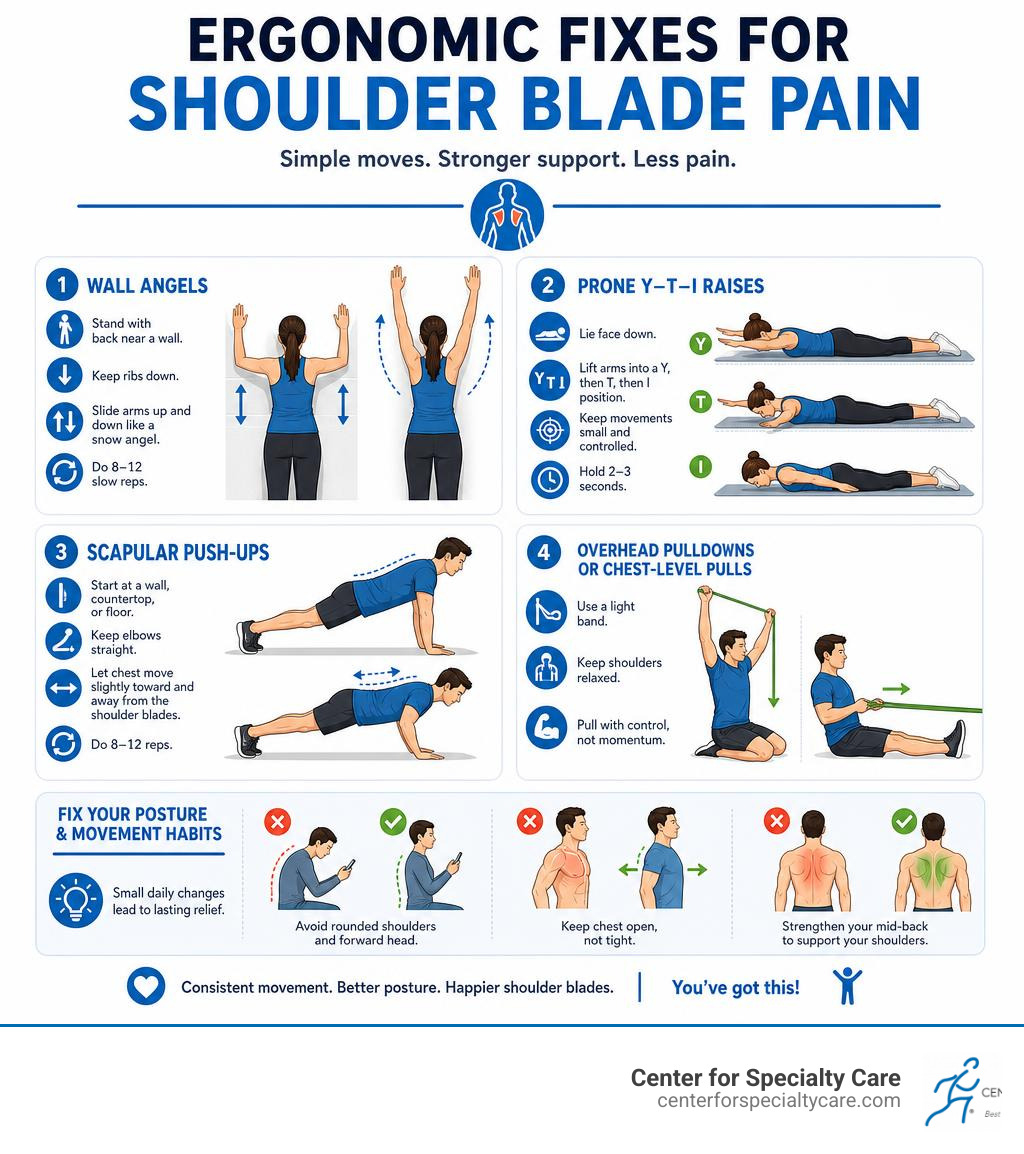
Why Tech Neck and Rounded Shoulders Cause Scapular Pain
When your head drifts forward, the neck and shoulder blade muscles work harder to hold it up. Over time, this can lead to:
- Cervical strain
- Overworked rhomboids and trapezius
- Tight pectoral muscles
- Weak middle and lower trapezius
- Shoulder hiking
- Shallow breathing
- Trigger points
- Fatigue between the shoulder blades
This cycle is sometimes called upper crossed syndrome. The fix is not simply “sit up straight forever.” Nobody wins that game. The real fix is better ergonomics, frequent movement, and strengthening the muscles that support good posture.
Ergonomic Fixes for Desk, Phone, Driving, and Sleep
Try these daily changes:
Desk:
- Keep your monitor at eye level.
- Support your elbows or forearms.
- Keep wrists neutral.
- Sit with feet flat.
- Use lumbar support.
- Keep shoulders relaxed, not shrugged.
Phone:
- Raise the phone closer to eye level.
- Take breaks from looking down.
- Use voice features when possible.
Driving:
- Sit close enough that shoulders stay relaxed.
- Avoid reaching forward for the wheel.
- Use lumbar support if needed.
Movement breaks:
- Every 45-60 minutes, stand up.
- Do 5 shoulder rolls, 5 chin tucks, and 5 deep breaths.
Sleep:
- Back sleeping: use a pillow that supports the natural neck curve.
- Side sleeping: hug a pillow to support the top arm.
- Avoid stomach sleeping when possible because it twists the neck for hours.
How Physical Therapy Helps Scapular Dyskinesis and Muscle Imbalances
Physical therapy is often the first-line treatment for musculoskeletal scapular pain. A good PT plan does more than hand you a sheet of exercises. It looks at how your shoulder blade, neck, thoracic spine, ribs, and shoulder joint work together.
Physical therapy may include:
- Movement assessment
- Scapular tracking evaluation
- Strength and flexibility testing
- Posture assessment
- Manual therapy
- Motor control training
- Nerve screening
- Progressive loading
- A home exercise plan
If symptoms suggest nerve irritation, evaluation becomes especially important. Learn more about nerve-related symptoms in our guides to pinched nerve in shoulder blade and pinched nerve scapula.
When to See a Doctor, Physical Therapist, or Specialist
Home care is reasonable for mild, clearly mechanical pain. But if symptoms persist, worsen, or limit your life, it is time to get help.
See a medical professional if you have:
- Pain lasting more than 1-2 weeks
- Worsening symptoms despite self-care
- Limited shoulder or neck range of motion
- Pain interfering with work, sleep, or daily activity
- Recurrent knots that keep returning
- Night pain
- Pain after trauma
- Numbness, tingling, weakness, or grip changes
- Suspected disc or nerve issue
- Scapular winging or visible abnormal movement
- Any concern for heart, lung, or gallbladder-related pain
Evaluation may include a physical exam, X-rays, MRI, EMG/nerve studies, or other testing depending on symptoms. Most patients start with conservative care, but injections or other interventions may be considered when appropriate.
For more guidance, read Why your shoulder blade hurts and how to fix it.
How Long Scapular Pain Usually Takes to Resolve
Recovery depends on the cause:
- Minor muscle fatigue: often improves in 3-7 days
- Mild strain: commonly improves in 1-2 weeks
- Posture-related pain: often improves over 4-6 weeks with consistent changes
- Chronic muscle imbalance: may take several months
- Nerve compression or disc-related pain: timeline varies and needs evaluation
Up to 70% of people with chronic shoulder blade pain may improve significantly within 4-6 weeks when care combines posture correction, targeted strengthening, and manual therapy. Consistency matters. Doing exercises once and expecting permanent relief is like brushing your teeth once and announcing you are done for life.
Signs Conservative Care Is Not Enough
Get reassessed if you notice:
- Pain lasting beyond two weeks
- Repeated flare-ups
- Pain spreading into the arm, chest, or neck
- Numbness, tingling, or weakness
- Grip changes
- Sleep disruption
- Inability to work or perform normal activities
- Failed self-care
- Suspected dorsal scapular nerve irritation
- Scapular winging, popping, or loss of control
Persistent knots are not always just knots. Sometimes they are a sign of deeper movement dysfunction, nerve irritation, or referred pain. See Beyond the trigger point for more on stubborn shoulder blade symptoms.
Frequently Asked Questions About Scapula Pain Relief
What Is the Fastest Way to Relieve Pain Under the Shoulder Blade?
First, rule out red flags. If symptoms are mild and clearly muscle-related, the fastest plan is:
- Rest from the irritating activity.
- Use ice for new pain in the first 48-72 hours.
- Switch to heat for stiffness or chronic tightness.
- Do gentle mobility, such as shoulder rolls and chin tucks.
- Try light self-massage with a tennis ball against a wall.
- Use OTC medication only as directed and only if safe for you.
- Correct the posture or activity that triggered it.
Fast relief is helpful. Lasting relief usually requires strengthening and better movement habits.
Is Pain Under the Left Scapula Always a Heart Problem?
No. Muscle strain, posture, neck irritation, and rhomboid pain are common causes of left scapular pain.
However, left-sided shoulder blade pain should be taken seriously if it comes with:
- Chest pressure or tightness
- Shortness of breath
- Pain into the jaw or left arm
- Nausea
- Sweating
- Dizziness
- A heavy, deep pain that does not change with movement
Those symptoms require emergency care.
Can Stress Cause Pain Under the Scapula?
Yes. Stress can cause shoulder hiking, jaw clenching, shallow breathing, and muscle guarding. Over time, that can create trigger points in the upper trapezius, levator scapulae, and rhomboids.
Helpful stress-related fixes include:
- Slow diaphragmatic breathing
- Short movement breaks
- Heat for muscle tension
- Gentle stretching
- Relaxing the shoulders several times per day
- Regular strengthening and walking
Stress pain is real pain. It is not “in your head.” It is in your nervous system, muscles, posture, breathing, and daily habits.
Conclusion
Learning how to relieve pain under scapula starts with the right sequence: rule out red flags, calm acute irritation, restore mobility, strengthen the scapular stabilizers, and fix the posture habits that keep re-triggering the area.
Most shoulder blade pain improves with conservative care, but persistent pain deserves a closer look. At Center for Specialty Care, we offer personalized orthopedic and pain management care for patients in Fairmont, Estherville, Buffalo Center, St. James, and surrounding Minnesota and Iowa communities. We provide both surgical and non-surgical options, with a focus on quick appointment availability, individualized care, and 100% patient satisfaction.
If your shoulder blade pain is not improving, we are here to help you find the cause and build a plan that actually fits your life.